Showing posts with label Black Ratsnake. Show all posts

Saturday, March 2, 2019

In the Footsteps of Conant: Herping Ohio’s Hill Country

“Also, there were many objects to overturn, and there was always the chance of finding something unusual beneath any log or rock. Springs and both clear and muddy streams abounded. In short, there was a great variety of habitats to be explored. The net result was that we probably spent more man hours in the hill country than in any other part of the state. Southeastern Ohio was unquestionably our favorite collecting area.”

—Roger Conant
Herpetology in Ohio—50 Years Ago 

Stories about herping in Ohio
Northern Red-bellied Snake.
Gravel crunched under our tires as we pulled off Route 50 onto the first backroad of the day.  The morning sun was already beginning to bake away any evidence of last night’s rain, but by midday, our sweat-stained shirts and hair would look as if a storm had caught us by surprise.  My backpack held two full water bottles, a tablet of dissolved electrolytes in each.  A third and a fourth were stashed below the rear seat next to Carl’s water-filled orange juice containers.  Neither of us wanted to tempt fate by running out of water in the heat of Ohio's Hill Country.

As we pulled to a stop along the roadside, the fluttering hum of cicadas died down and the air hung still for a moment as if the forest was waiting to inhale.  I grabbed my snake stick from the bed of the truck as Carl slipped his backpack over his head.  We both knew the drill.  The hillsides all around us held promise of snakes, lizards, and turtles hidden below cover.

Stories about Ohio's Hill Country
Eastern Black Kingsnake.
During each of our treks into Ohio’s backwoods, I can’t help but feel we are a small instance of history repeating itself.  Just shy of a century ago, Roger Conant might have hiked these very same hillsides and ravines.  In the 1930s, Conant was the first to attempt an exhaustive survey of Ohio’s reptile diversity (an undertaking sorely in need of updating since the previous survey by Kirtland in 1838).  During his six years as Curator of Reptiles at the Toledo Zoo, he would eventually make it to 87 of Ohio’s 88 counties, drive some 41,000 miles, collect countless voucher specimens, and publish his collective work in The Reptiles of Ohio in 1938.  

Like us, weekends were Conant’s designated field days.  He would travel from his home base in Toledo, accompanied by a small and variable band of zoo colleagues, local naturalists, and a few wide-eyed teenagers, all eager to indulge their persistent childhood urges to catch the scaly and slimy.  The crew would pack snake bags and collecting jars into Roger’s 1931 Chevy and set out for the unknown.  Their findings were quintessential, helping to verify species records and contributing to the state’s first range maps.


Adventures searching for Ohio's reptiles and amphibians
Eastern Smooth Earthsnake. 
Conant’s work wasn't limited to Ohio alone.  Take down your copy of A Field Guide to Reptiles and Amphibians of Eastern and Central North America and you’ll find a conspicuous authorship.  For most of us fascinated with reptiles and amphibians (Carl and myself included), this field guide was our ticket into the world of herpetology.  Anyone who herps Ohio today (or anywhere in North America) is indebted to the work of Conant and his colleagues.  

For over 15 years, Carl Brune has spent his free weekends and rainy evenings ‘filling in Conant’s gaps.’  Originally from California, Carl moved to Ohio to teach physics at Ohio University.  He has helped to expand the known ranges of species from copperheads to streamside salamanders, and has even authored two chapters in the Amphibians of Ohio Textbook.  


Stories about Roger Conant and Herping in Ohio
Northern Copperhead.

I began herping with him in late August 2017.  Growing up in a suburb of Cleveland, reptile diversity was somewhat lacking.  For as long as I can remember, I’ve dreamed of seeing the creatures hidden among the rolling hills of Ohio’s southern counties.  In 2016, I moved to Athens to study Wildlife Biology and Conservation.  By luck or fate, I found myself in the middle of one of Ohio’s most herpetologically diverse regions.  
Stories Herping in Ohio
A map of the physiogeographic regions of Ohio from Conant's The Reptiles of Ohio.
It is no secret that Roger Conant preferred the Hill Country over any of Ohio’s other physiogeographic regions.  Eleven of the thirty reptile species he documented there were found nowhere else in the state.  The Hill Country encompasses the southeastern third of Ohio and sits on the Unglaciated Allegheny Plateau at the base of the Appalachian Mountains.  Except for the blue grass region, the Hill Country is the only part of Ohio that was free of ice during the Pleistocene.  When the glaciers receded at the end of the last ice age, their melt waters carved out the labyrinth of ravines and hilltops that define the Hill Country of today.  
Adventures in the Hill Country of Ohio
Black Racer.
Before the arrival of Europeans, 95% of Ohio was covered by huge stands of old-growth forest.  Oaks and hickories cloaked the rolling hills and provided habitat for wolves, bison, elk, black bear, and even wolverine.  By the beginning of the 1900s, the state’s megafauna would be gone, and the forest would be reduced to 10% of its former grandeur.  The trees were cleared for timber and to allow access to the exposed layers of coal, iron, and oil.  Once these natural resources were fully exploited, industry moved on, and the forests were allowed to regrow.  Remnants of old coal towns and iron districts still stand in isolated pockets of the backwoods, totems to this past age.  
Herping in Ohio adventures Roger Conant
Northern Ring-necked Snake.
By the 1930s, second-growth had returned to much of southeastern Ohio.  Conant described the state of the forest in his autobiography, “The charm of the hill country lay largely in the fact it was mostly wild in those days.  Agriculture was confined to some of the valleys, and second growth had re-clothed the hillsides and many other areas to the point where the forest had more or less returned to its original climax stage.”  As much as 70% of the Unglaciated Allegheny Plateau is now forested.  Glacial melt waters washed away most of the area’s rich soil, sparing the land from agriculture.  Had the soil been more profitable, the Hill Country would likely be a very different place today.
Despite the disappearance of many of Ohio’s native fauna during this era of rapid and intense deforestation, there have been no documented extinctions for any of Ohio’s 47 species of reptile or 40 species of amphibian.  Just how and where these fragile creatures survived is something of a mystery.  Logging took place over many decades, and it is possible species found refuge in small, remaining tracts of habitat, recolonizing the surrounding land once the forest had regrown.  Considering the scale of habitat loss that swept through Ohio in the 1800s, it is remarkable any native herpetofauna survived at all. 
Ratsnake in Ohio's Hill Country
Black Ratsnake.
One thing is clear, however, Ohio’s reptiles and amphibians are no strangers to adverse environmental conditions.  A year (or even a day) in Ohio can fluctuate wildly in temperature and weather conditions.  Winter lasts for nearly half the year, forcing ectothermic species to remain inactive for months on end.  Summer is prime herping season, but with midday temperatures easily reaching 90 degrees Fahrenheit in southern Ohio, most species are forced to seek shelter to avoid overheating or desiccating.  

Logs and rocks provide cool, moist places for snakes to hide during the heat of the day.  Nature, however, can be supplemented with a little human ingenuity.  In Conant’s time, logging operations left behind huge saw dust piles strewn along the steep slopes.  When covered with pieces of hacked-off bark, these damp, sturdy piles provided the perfect escape from the elements.  Conant recounts one exceptionally good find, “a large slab-covered pile in Hocking County yielded a fence lizard, three young broad head skinks, a northern water snake, eleven hatchling black rat snakes, and two juvenile copperheads.”   As mill practices shifted, Conant’s fruitful saw dust piles became a thing of the past.  
Herping with Conant
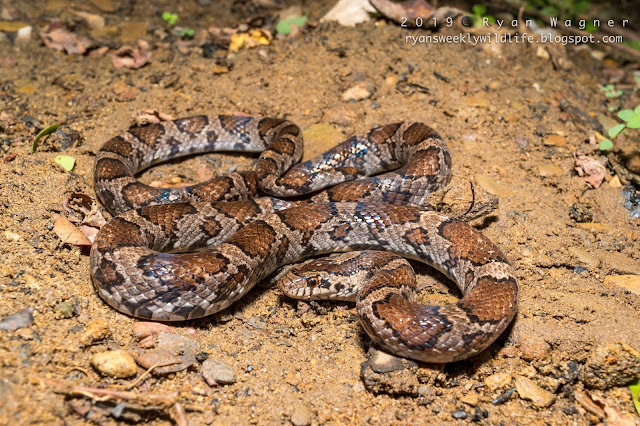
Eastern Milksnake.

Today, man-made cover is still important for finding snakes.  Plywood boards and tins scattered throughout the roadsides and hilltops of southern Ohio are easily flipped and are a proven way to find scads of snakes in an otherwise desolate landscape.  Reptiles aren't picky; old pool liners, ratty carpets, deck chairs, smashed televisions, and gas tanks might be an eye sore for most hikers, but for folks like us, they’re a treasure trove.  A good trash pile always gets my blood pumping in anticipation of what might be lurking below.

During the course of our search, Carl and I might flip upwards of 100 pieces of cover and hike ten miles through the ravines and hilltops, all to find a handful of serpents.  Somedays, the snakes are plentiful, others require hours of work to find the most common of species.  There is really no telling where or when a species might turn up; it's often a matter of being in the right place at the right time. 

Carl Brune and Ryan Wagner herping adventures
Eastern Wormsnake.
Carl and I have been lucky enough to find more snakes in Ohio than most people will see in their entire lives.  Even where snake populations appear stable, however, the impacts of humans are plainly visible.  Whether it be road mortality, habitat loss, or direct persecution, "snakes engender mighty little sympathy from the general public," a statement that still rings true today. 

Conant was well aware that with each decade, more species were pushed closer toward extirpation.  Fifty years after his surveys, Conant lamented that, “many places that once supported thriving colonies of various species have vanished.”  Rattlesnakes, spotted turtles, Kirtland’s snakesspecies Conant would have commonly encountered in his dayhave all but disappeared from most of the state.

Ryan Wagner and Carl Brune Herping In Ohio
Timber Rattlesnake.  

Conant laid the ground work for our modern generation of herpetologists.  It is now up to us to protect the species and populations that remain.  Efforts to mitigate the damage we have done to our natural environment can often seem confusing and convoluted, but I have found there is something very down to earth about the study of reptiles and amphibians.  Even someone unaccustomed to the complex and long-winded jargon of scientific literature might be able to detect a hint of the adventure and mystery only thinly veiled behind tables of snout-vent lengths and scale counts.

Hobby, obsession, the ‘weird’ cousin of birding, call it what you will, but herping has captivated my life ever since I first opened Roger Conant's field guide.  In a few months time, the snakes, lizards, and turtles will begin to emerge from their frozen retreats. Carl and I will soon be back among the rolling hills of Southern Ohio, flipping logs, boards, and carpets for the secrets hidden beneath.  Only time will tell what we find.

Herping Ohio Nature Snake Hunting
Carl and myself after a day of dip netting for salamanders in 2018.
Ryan Wagner is a student studying Wildlife Biology and Conservation at Ohio University.  He is an avid herper, birder, nature blogger, and wildlife photographer.  You can read more of his articles at ryansweeklywildlife.blogspot.com or follow him on twitter @weeklywildlife.  You can read the guest post version of this blog at Jim McCormac's Birds and Biodiversity Blog.


Monday, May 28, 2018

Out Herped: Life of a Wildlife Student

The more I learn about the world of reptiles and amphibians, the more baffled I become.  Many would dismiss these slimy and scaly creatures of the mud and earth as dull or disinteresting, but herps (the less than glamorous term used to describe them) never fail to surprise me.  The secretive nature of herps conceals much of their life history from would-be observers, making them more challenging to apprehend than our fellow, quick-paced mammals or melodious and vibrant birds.  But herps conceal a charm and an allure known all too well by those who seek them.  This drive, to encounter wild creatures on their own terms, is shared by all who wish to grasp the true nature of wildlife.  Observing an organism first hand provides an insight that can’t be found through any book or website.  Kneeling down to their level changes your perspective.  It’s the ectotherms that make the world go round.  

Field Life
My study for finals when you can catch
snapping turtles on campus?
Herps have captured my imagination in a way few other creatures have.  I just can’t escape these cold-blooded fiends.  They were my portal into the weird and wonderful world of biology that has preoccupied my life ever since. 

The personal lives of reptiles and amphibians take place on a smaller scale compared to those of birds or mammals.  Most are relatively slow and sedentary, others are capable of only short burst of speed, lacking the endurance to travel beyond their limited home range.  While its possible (with great luck and skill) to see just about every migrating warbler species in the span of a few days to weeks in one location (Magee Marsh comes to mind), there is nowhere in Ohio where you could see every salamander species occurring together.  Herps tend to exclude or replace one another across their range, especially when closely related species are involved.  You might find eastern milksnakes in one township, but switch to eastern black kingsnakes just a few miles into the next.  This creates a patchwork of native species, some overlapping, others with ill-defined, but very real boundaries.

Herps are intimately tied to their environment in a way endotherms are not.  They depend not only on a suitable temperature range, but also on the proper topography, soil type, and moisture levels.  If you know the right habitat for your species of interest, then your odds of discovery are greatly improved.  This is one of those things, however, that sounds better on paper than in practice.  For reasons that allude most herpers, some species have never been documented in habitats that seem perfectly suitable for them.  Others pop up in places where you would never start your search.  It is often said that herp range maps better reflect the distribution of herpetologists rather than the animals themselves. 

Field Life
And water snakes too...
To observe a certain species, one must thoroughly explore the habitat in which a population can [potentially] be found.  I can think of no better example for the proverbial needle in a hay stack.  Some species can be discovered with just a little luck and persistence.  If enough time is spent hiking through the woods, a garter snake or a painted turtle will eventually offer a glimpse of their presence.  A timber rattlesnake, on the other hand, is not so easily discovered.  The rugged, rocky, and densely forested landscapes that these snakes haunt are challenge enough to explore.  The low abundance of this species (from years of human persecution), their secretive nature, and their camouflage, make timber rattlers one the the hardest herps to discover in Ohio. 

The trouble with herping is that it’s not a localized activity.  It’s a scavenger hunt spread throughout the state without the convenience of eBird or a community that readily shares locations and sightings (usually for the safety of vulnerable populations).  The time it would take to locate the nearly 80 species of herps in Ohio by yourself would be staggering.  To have success with even a single species, you need a well thought out plan, familiarity with the area, and an intimate knowledge of the creature for which you are searching.  Or even better: someone else who knows where to look and a little dumb luck.

This is where science can really help out an aspiring wildlife student.  Getting involved with undergraduate research has provided me with incredible opportunities and introduced me to species I'd never dreamed of finding.  I've been able to trap, measure, weigh and toe clip (yes indeed) everything from turtles to frogs, newts, and salamanders.  I've accompanied graduate students out tracking timber rattlesnakes and am currently working as a lead tracker on a box turtle study.

Field Life
The swamp team in our very fashionable waders.
I’ve become somewhat known as the self-proclaimed herper who just can’t find a black ratsnake (somehow, this topic always works its way into my conversations).  I sometimes feel like I go around saying, “Hi! I’m Ryan Wagner and I’ve never seen a ratsnake (and obviously really really want to),” only to hear about a snake that the listener saw just days earlier (herper or not).  Ratsnakes represent everything I love and hope to achieve in the pursuit of reptiles and amphibians.  They are our longest native snake, are usually docile when encountered, are down right common, and yet, despite a lifetime of searching, I had never seen so much as a shed skin.  I’ve written about my ratsnake nemesis HERE. Last month, thanks to the community of biologists I've come to know, I finally found my ratsnake.

Field life
My first (and only) hog-nosed snake
It was during a Bioblitz at The Ridges, the system of nature trails just beyond campus, where my fateful encounter finally took place.  Grad student Charlene Hopkins had orchestrated a survey of the land lab to document the various species that occur there.  I knew one of the teams was bound to find a ratsnake.  If you've never heard of a Bioblitz before (I know I hadn't) it works like this: A team leader, armed with clipboard and data sheet, and a small group of undergrads, attempt to record every species they can find in an acre plot.  No insect, wildflower, bird call, salamander, or lichen goes untallied. It's really a fantastic time and great opportunity to show of your newly developed plant identification skills (wink, wink).  

My team did not find the ratsnake, but the team next to us did.  "Don't you still need a rat," one of the grad students called to me.  Of course I did.  On our hike over to see if the snake could be refound, my friend and fellow turtle tracker Eva Gracia asked, "What are you going to do if we find it? That's like, your whole persona."  I had to admit, I was a little nervous.  After a few minutes of searching, it seemed the snake had alluded me once again, but then, someone shouted that they had found it slinking away across the trail.  Stupefied, I picked the snake up.  As one of my lab mates hiked up to our huddled group, he exclaimed, "Ryan! Ryaaan!" just as shocked about the species of serpent I was holding as I was.  Since then, the floodgates have opened and I have found two more black ratsnakes.


Field Life
Me and my rat snake at long last.
I would like to believe that my lack of success with some species hasn't been due to lack of effort.  I used to joke about “out-herping” everyone I had ever been in the field with.  That is, until I met Carl Brune.  When out hiking, I am always itching to flip “just one more rock,” inadvertently adding another hour and a half to the journey.  Many of my past herping companions have sworn to “never again” accompany me on one of my adventures.  I used to find this funny and chock it up to lack of interest or commitment on their part.  Call it passion or sheer stubbornness, I can't help but imagine what might lie beyond the next bend.  If there is the potential to find something new and fascinating, then why not flip just one more rock?  How foolish I was.

Field Life
Carl started bringing me along on his herping expeditions late last August.  I quickly learned that a trip into the field with Dr. Brune constitutes a full day endeavor.  On Sunday mornings (around 8 am), Carl would swing by the OU campus to pick me up.  I’d usually be standing awkwardly in front of Clippinger Laboratories, dawned in full field gear, backpack, and with snake hook in hand.  Fellow students would spare me puzzled glances as they walked past.  I just grinned back—snakes and salamanders the only thing on my mind.  The day's trek could hold anything.  
Field Life
An eastern black kingsnake Carl flipped.

Carl is truly the kind of herper that has forgotten more about reptiles and amphibians than most will ever know.  He is always glad to share his thoughts on my endless herp-related questions.  Carl is a treasure trove of knowledge; if he doesn't know the answer, there are likely few out there who do.  He has explored just about every back country road and woodland strip in southern Ohio with enough space to park a truck along. 

I sometimes wonder what other hikers must think when they come upon the tell-tail signs of a Brune.  Evenly spaced wooden boards and neatly folded carpets hauled out of reach of most trash pickers and placed along the edge between tree line and field must be a puzzling sight for the non-herp oriented hiker.  Cover objects, like these, draw in reptiles and some amphibians, making their discovery more reliable.  Flipped board by flipped board, Carl has picked apart the secrets of southern Ohio’s herpetofauna.  He knows these creatures and their habitats more intimately than anyone I have ever met.  

Even with his years of experience, Carl admits that many aspect of herps still baffle him.  “I don’t pretend to understand it, but…” he often begins when answering my barrage of questions.  The complex relationships between different species distributions, where each occurs and why,  is something that no one fully understands.  The main goal behind Carl’s herping trips (besides just catching and photographing cool critters) is to further the knowledge and understanding of Ohio’s southern herps.  He has helped to expand the known ranges of species from copperheads to streamside salamanders.  Carl has even authored several chapters in the immense Amphibians of Ohio textbook (American toad, Fowler's toad, and mud salamander).  It is a privilege to herp alongside him.  


Field Life
Carl and me during one of our recent herping trips.
On the truly long days (which can push 12 hours in near 90 degree heat), I try to keep my legs going if not my brain.  My endless questions eventually lapse into a dulled silence as exhaustion sets in.  Upon returning home, I often collapse into bed muttering a slightly dehydrated, “I never want to see another snake again.”  Without looking up, my roommate reminds me that I’ll feel differently by morning.  He’s right after all.  After the shock of being out-herped wears off (for the umpteenth time), I'll be itching to get back out into the field again.  Out-herped or not, who could stay inside with all the rocks out there to flip?

Thanks for reading and keep living the field life!
RBW  

Wednesday, August 16, 2017

My Nemesis

Every wildlife watcher has a nemesis.  That species that proves elusive despite persistent  efforts to find it.  Birders speak of theirs in hushed tones, “Everyone and their grandmother had a picture! I drove two hours, hiked six, and never saw its dumb face.”  Herpetologists get glassy-eyed and distant, “Flipped every rock, every log—nothing.”  A nemesis captures the imagination in a way that other species don’t.  Each evasion feels like a personal slight.  It sparks an obsession, a lifelong quest to see what so many—or so few—have seen.  A nemesis is the creature that keeps you up at night.  It haunts your dreams with imagined delight or insufferable escape.  It resides in the recesses of your mind every time you leave the house.  Optimists hold perpetual hope: maybe tomorrow, maybe tomorrow; pessimists shake their heads: never, never.
 
I admit, I have been on both ends of the spectrum.  For as long as I can remember, the creature that has resided solely in my imagination is the gray ratsnake (Pantherophis spiloides).  In Ohio, it is more commonly referred to as the eastern or black ratsnake.  The herpers among you may be puzzled.  You may be asking yourself, “has this guy never been outside?”  Congratulations, you can understand my frustration at never having seen one.  The funny thing about ratsnakes is: they aren’t rare.  They are downright common.  Telling a snake enthusiast you have never seen a ratsnake is like telling a birder you have never seen a red-winged blackbird.  It’s like telling a mammalogist you’re dying to see a squirrel.  It’s like confiding in a cryptozoologist that you have seen exactly the same number of ratsnakes as bigfoots. 

black ratsnakeLet me clarify.  I have seen black ratsnakes in captivity.  During high school, I volunteered with the Cleveland Metroparks, handling the same big female ratsnake, Olive, every Saturday for four years.  I can honestly say (with volunteer hours as proof) that I have spent more time with that ratsnake than with many people I claim as friends.  Black ratsnakes sparked my fascination with Ohio reptiles and amphibians.  Not only are they our biggest native snake (growing up to 8 feet), but they are also incredibly docile.  I allowed people of all ages to interact with Olive, and she never bit or acted aggressively towards anyone.  I am proud to say she captivated hundreds of visitors, including myself.  

We kept other species of snakes, turtles, and frogs at the nature center, but Olive was what always brought me back.  I often found myself transfixed by her beauty and elegance as she slowly pulled herself up the branches in her tall, rectangular enclosure (essentially a specially designed fish tank turned on its side).  Children would huddle around Olive for hours, examining her bright round eyes, laughing at the flicks of her tongue, and remarking at the smoothness of her scales.  I never missed the chance to introduce a cautious family or an excitable grandmother to our friendly resident rat.  I watched as fear always gave away to curiosity and then joy.  It was uplifting how this seemingly unlovable creature could melt the hearts of so many.  

Ratsnakes are nonvenomous members of the colubrid family (containing most of North America's harmless serpents).  They are true constrictors, feeding on mice, rats, frogs, eggs, and anything else small enough for them to catch.  Natural climbers, ratsnakes are as likely to be found in the canopy as they are in the rafters and boards of barns, sheds, and decks.  Their affinity for human habitation has resulted in their pointless persecution by fearful homeowners. Ratsnakes are mild-tempered, striking only in self defense.  They directly benefit us by keeping disease-carrying rodents in check. 

black ratsnake

So began my quest to find a wild ratsnake.  I scoured what seemed like every inch of the metroparks, turning up garter snakes, watersnakes, turtles, frogs, owls, beavers, raccoons, herons, etc.  Everything but a black ratsnake.  During my searches, I fell in love with the other creatures of the forest.  I learned to identify the songbirds and recorded all the wildflowers I could find.  I photographed and kept field notes; I talked and shared experiences with naturalists and visitors.  All the while my eyes and ears were tuned to the slither of something larger, the glint of black scales.

I have many fond memories of camping with my father at Findley and Salt Fork State Parks.  We would hike the day away, exploring every nook and cranny for my phantom snake.  When our own searches didn't turn up a black rat, we joined the Northern Ohio Association of Herpetologists.  In NOAH I met many experienced herpers and breeders and traveled to new locations around Ohio in search of the scaly and slimy.  Still no ratsnakes.  

Black ratsnakes occur throughout Ohio, but are more prevalent in the southern portion of the state.  When I got the chance to visit The Wilds, a large mammal conservation and breeding facility in Cumberland, Ohio, I felt certain the odds were in my favor.  I woke early each day to explore the campground.  On hikes, I bombarded the naturalist guides with questions about the serpents.  They informed me that ratsnakes were so plentiful they often had to stop their tour buses to move them off the road.  Safe to say I didn't find one.

black ratsnake

On to college.  I often joke that I chose Ohio University 30% for the wildlife and conservation biology program and 70% to look for the reptiles around it.  Naturally, my first question for the OU Wildlife Club officers was “have you seen a ratsnake?”  “Yes” was the universal reply.  I felt confident.  I didn't have to find one immediately; I had time.  Between and after classes, every chance I got, I hiked up to The Ridges (OU’s old asylum and nature trails).  I spent hours exploring every trail and field until I knew them as well as any park I had ever visited.  No stinking ratsnakes.  I went on every hike and trip the club offered.  No ratsnakes.  Those two ominous words were beginning to work their way into my consciousness.  Never?  Never?

Then I got the opportunity of a lifetime: to be a field technician for a box turtle study.  I vividly remember telling Marcel, the master’s student conducting the study, “Ratsnakes are kind of my nemesis.”  “Oh, because they can be aggressive?” she asked.  To her utter surprise, I explained that it was because I had never found one.  “We’ll find one,” she assured me.  We laugh about this now.  A fellow wildlife enthusiast told me, “It’s funny you have seen timber rattlesnakes and spadefoot toads, but never a ratsnake.”  I assured him that the irony was not lost on me.  

black ratsnakeTo date I have never found a wild ratsnake.  I have seen half a dozen dead on the road.  I have seen and photographed ratsnakes found by other field technicians on other field projects (but animals in the lab don't really count).  We have found four foot black racers and box turtles to spare.  But no ratsnakes.  I had planned to write this post once I finally found my ratsnake, but this is somehow more fitting.  I don't doubt that I will one day find a black rat.  It will probably be a day like any other.  I’ll be out hiking, or road cruising, and our paths will finally cross.  I will check another lifer off my list.  It will be like any other encounter, but it will also be a moment to reflect upon.  I will stop, snake in hand, and breath a sigh of relief.  The search will be over.  

In many ways, however, the search will have just begun.  Ratsnakes, from their hidden realms, have influenced my life in a way no other creature has.  They sparked the passion that today defines me.  My drive to find these illusive serpents introduced me to the natural world.  My fruitless searches turned out to be quite the opposite.  I found creatures I had never dreamed of finding.  I learned to be patient, to accept defeat, and to keep trying. 

I will forever be an advocate for the voiceless and defenseless creatures of our world.  In particular the hard-to-love, the uncharismatic, the slimy, the scaly, and the potentially dangerous.  I hope to change the hearts and minds of people who would look upon a snake with distain, fear, or malice.  John Burroughs, an American Essayist, famously said, “You must have the bird in your heart before you can find it in the bush.”  If the same holds true for snakes then maybe tomorrow, maybe tomorrow. . .

More Articles