A white silhouette lifts into the air on broad, white wings. White feet plunge into white snow; black, recurved talons quickly sever the vertebrae of an unsuspecting vole. A satellite dish head bends down to grasp its prize with an equally sharp, black bill. Vole dangling limply, the great bird lifts into the air again, flying a short distance to perch on a nearby fence post. Upon landing, she returns the prey to her feet and surveys her surroundings, golden eyes blazing in the early morning light. Finding no adversary on the open landscape, the owl settles into her meal. A few upward thrusts of the neck, and the vole disappears down her gullet, leaving a scarlet smear across her white whiskers. Crop full, she ruffles her feathers, appearing for a moment twice as large as she truly is. Her eyelids begin to droop—falling from the top down, she looks eerily human. Not a hundred yards away, a group of photographers and birders stand witness to this rarely seen northern spectacle.
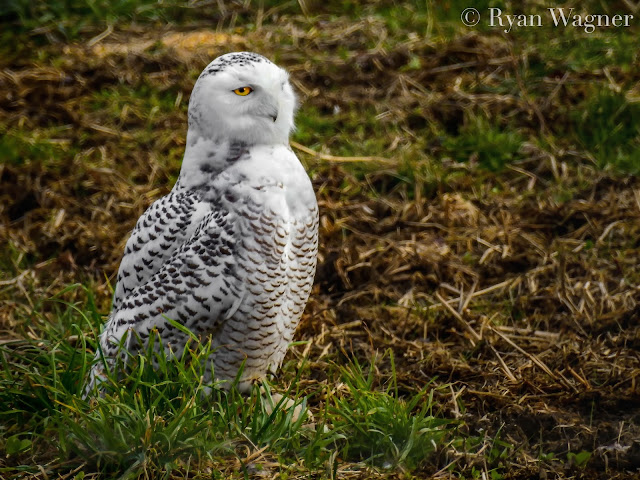
Snowy owls (Bubo scandiacus) exhibit irruptive migration patterns as young birds travel from the arctic breeding grounds to winter in northern states. Some years, there can be as few as two owl sightings along the entire Lake Erie shoreline. In others, snowies can irrupt across the northeast in the hundreds. During the winter of 2013-14, snowies broke a century record, reaching as far south as Florida and the Bahamas.
So what causes this erratic descent upon the lower forty-eight? The short answer: lemmings. Brown lemmings are a keystone species in the arctic, providing food for countless predators. Lemmings exhibit a cyclic population, rising and falling in numbers every 3-4 years. Rapid reproduction means three lemming generations can be born in a single summer. With this influx of hungry mouths, lemmings eat themselves out of house and home. Coupled with an increase in their predators (such as owls), lemming populations eventually crash. This dance between scarcity and abundance of both prey and predator has driven arctic evolution for millions of years.
 |
| A screenshot of the eBird map for snowy owls in late 2017. |
In boom years, snowy owls can fledge as many as ten chicks. Come winter, young owls get kicked out of their parent’s breeding territories. They fly south to greener, milder pastures where they turn up in areas that resemble the arctic tundra (eg. airports and farms). Owls that find good hunting grounds can stick around for months, often until March or April. With so many young and inexperienced birds, irruption years can mean utter chaos.
One thing is always certain, however: when snowies irrupt, so do birders. These owls draw bird-lovers like bees to honey. If a snowy shows up near you, you can bet that a gaggle of camera toting, binocular clad enthusiasts won't be far behind. This winter, 2017-18, is looking like another irruption year for the arctic birds. Some 50 individuals are thought to have already made their way across Lake Erie and into Ohio.
 |
| A closer look at Ohio. |
For years, I have chased snowy owls without success. I always seemed to be one step behind. This past November, I decided to try my luck at the Lorain Impoundment in northeastern Ohio—a spot where snowies are known to frequent. A bird had been reported regularly for the last week, flooding the internet with images and stories. Arriving early on Thanksgiving morning, I was encouraged to see the impoundment already crawling with birders. Dozens of huge, tripod-mounted lenses were slung over shoulders or pointing out towards the embankment. I did the rounds, asking others what they had seen. Long story short, duck hunters had scared the bird away.
That same Thanksgiving day, another snowy owl would show up on a farm nearly 100 miles away in Holmes County. The bird in question (soon to become famously known as the Holmes owl) would remain on the farm for weeks, giving hundreds of birders excellent views of one of Ohio’s most beautiful winter residents. The farm’s owner, Orris Wengerd, graciously allowed owl-seekers from all parts of the state (and beyond) to visit his farm for hours on end.
Having struck out with snowies so many times, I was tentative about planning a drive to Holmes County. Back at Ohio University, I recruited my close friend and fellow wildlife student, Amanda Szinte, to come along on a last minute owling trip. We left for Amish country while it was still dark, driving two and a half hours in search of my ghost bird.
As we pulled into the farm's driveway, I could see a white, huddled figure perched like a weathervane near the edge of the barn roof. For a moment, it didn't look real. It could have been a plush toy, stuck up there to fool us. But then the bird moved, rotating its feathered dome in that way only owls can. My heart began to race; there it was, the bird we had journeyed so far to see! I set up my tripod, one of over a dozen already there, and began taking shot after shot.
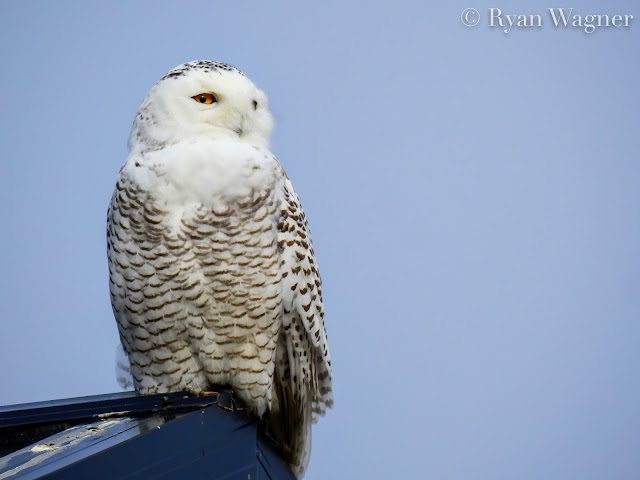 We stood behind a wooden fence in a designated viewing area, giving the bird plenty of space. The huge, white raptor was indifferent to our presence. Having quickly grown accustomed to us flightless humans, she snoozed the morning away. We hung on its every move, cameras and binoculars at the ready. I could hardly believe how close we were to this wild inhabitant of the arctic tundra. Trying not to draw too much attention to ourselves, Amanda and I did a subdued version of our happy dance.
The lighting came and went, as did other birders and photographers. There were at least twenty or so observers at any given time while I was there. For the next several hours, we stood shivering, watching the bird sleep. In this time, the owl moved little, save for its swiveling head. Most would find the monotony taxing, but not me; the excitement of seeing a snowy in the flesh made the time fly (no pun intended).
Unlike most owls, snowies aren't completely nocturnal. They are perfectly capable of hunting during daylight hours should the opportunity present itself. In their arctic home, the summer sun doesn't set for months on end. We saw several meadow voles that would have made an easy target for the powerful bird. Indifferent even to prey, she relaxed in the morning sun.
Suddenly, another, smaller raptor burst out from behind the owl. Everyone gasped as the Cooper’s hawk swooped low over us and landed in a nearby tree. The woman next to me nearly fell out of her chair. In our surprise, not a single shutter had fired. The owl, on the other hand, didn't even flinch. It had heard the comparatively noisy flight of the accipiter a long way off. The little Cooper’s posed no threat, and so, like us, was ignored.

Someone redirected my attention back to the bird on the roof. Looking up, I gasped; the owl was stretching her wings. I poised my finger over my camera’s shutter should the owl suddenly take flight. The bird leaned forward, extending her neck, eyes fixed on something we could not see. The group held a collective breath. You could have heard a pin drop, or a mouse squeak. Evidently, the owl heard neither. After several minutes of intense scanning, she settled back into her perch rather anticlimactically. I lowered my arms, stiff from the cold. I was actually relieved the bird hadn't flown. With my clunky tripod rig, there was a good chance I would miss the flight shot if I wasn't fully prepared.

Forty five minutes later, the owl took flight. Shutters fired like machine guns from every direction. The owl soared silently over the tall grass and landed on the ground at the far end of the fence. Having missed its meadow vole prey, the owl lifted into the air again and flew behind the barn and out of site. Assuming that was it for photographs, we all chuckled at how quickly the owl had alluded us. But then, just as the Cooper’s hawk had done, the great owl burst from behind the barn and flew directly at us. It was too fast for me to photograph; all I could do was gaze at its white underbelly and huge wings and talons as it soared over my head.

The owl touched down in a nearby field on top of what we hoped was a meal. I clambered my way through the surge of photographers to see what the bird was doing. The owl sat motionless, staring at its feet. It began walking in clumsy circles, evidently perplexed that it hadn't caught anything. It kept examining the same patch of earth, plodding gently with its huge, snowshoe feet.
After spending nearly 5 hours with the snowy, it was time for us to leave. We grabbed a quick lunch, and made one final pass by the farm. I smiled to see the owl perched back up on the roof as if she had never moved. We birders are indebted to people like the Wengerds for being so accommodating and welcoming. Their hospitality has allowed for nearly a thousand people to date to visit this great northern bird.
It is a sad fact that many of these first year owls will not return to the arctic in spring. Many perils await them among human habitation. When discussing the issue of ethics, snowy owls are the perfect storm. For starters, most of the owls migrating south are young, inexperienced birds. They have never encountered birders or photographers, let alone buildings, highways, and airplanes. Their home, the arctic tundra, is one big gray-scape. Devoid of trees, low grassy mounds serve as the highest perches. This explains the snowy’s tendency to “hide in plain sight.”
Sitting out in the open makes them an easy target for a whole assortment of trouble. One of the largest controversies surrounding these owls is “how close can you get?” The real question people should be asking is “how close should you get?” Owls tolerate a lot. They are quick to learn that a distant human is not threat, nor food. But approach too closely and the owl will start to get antsy. An owl’s personal bubble is much larger than yours or mine. Getting within a few meters just isn't acceptable. These owls have binocular vision, useful for spotting prey at a distance. The down side to this adaptation is their inability to focus on nearby objects. The closer you get, the harder it is for the bird to keep an eye on you.

Days after my visit to the Holmes owl, I learned some disturbing news. Several credible sources reported that the Wengereds were in fact feeding the owl. “Baiting” birds of prey is heavily frowned upon in the birding and scientific communities. The trouble with baiting owls is that it habituates them to humans. The birds become dependent on hand outs and lose their natural hunting instincts. Short term, it is easier to accept a free meal than to expend the energy it takes to hunt. When it comes time to return to the tundra, however, the owls lack the skills needed to survive in an unforgiving natural landscape.
I don't know why the Wengerds chose to feed the owl, but I have to believe they felt no ill will towards their arctic visitor. They were simply being hospitable to any man or beast that happened to show up on their doorstep. Who wouldn't want to help such a beautiful creature that chose to roost under your watch.
The misconception that migrating snowies are starving, however, has been thoroughly debunked. Starvation accounts for relatively few owl deaths each year. Irruption year birds actually tend to be fatter and heavier than years when lemmings are less plentiful. Birds that stick around humans for food are much more likely to be injured or killed. Collisions with vehicles, power lines, buildings, and air planes account for most deaths each year. Rat poison and electrocution are also major perils. Although it is illegal to shoot birds of prey, the occasional bullet has revealed the cause of death in more than one owl autopsy.
If direct impacts from humans isn't enough, climate change is poised to deliver the fatal blow. With less and less snow cover in the arctic each year, lemmings will be more exposed to predators. Without the privacy of their snow burrows, they will not be able to proliferate to owl supporting numbers. A future crash in the rodent population could set snowy owls on the path to extinction. Visit Project SNOWstorm for more about owl ethics.
So what's the take away? Don't get too close. Don't give them food. Appreciate them for their presence, not the photograph or the challenge. A little respect and knowledge can go a long way to protecting our northerly neighbors.
Thanks for reading.


