Showing posts with label Nature. Show all posts

Monday, February 4, 2019

Yasuni: Into the Amazon

Hot air whipped across the tarmac, buffeting my face as I shielded my eyes from the harsh glint of the plane’s dorsum.  We were scheduled to arrive in Coca in just over 40 minutes.  From there, we’d board a boat that would take us the rest of the way to the Yasuni Research Station.  The previous two days had been spent in Ecuador’s capital of Quito, getting accustomed to the culture and enjoying the bustling markets and restaurants.  So far, the trip had been rather relaxing, but now the vacation was over.  We were leaving behind the comfortable high elevation temperatures and descending into the heart and humidity of Yasuni National Park,  some 5000 square miles of untouched Amazonian Rainforest.   

As we began our ascent, the landscape quickly fell away and became shrouded by a blanket of churning clouds.  I scanned out into the white void, my eyes taking a moment to process a very real landmass jutting out of the clouds like a snow-capped island—one small peak of the Andes.  The mountain top looked as if a giant hand had scraped it across the clouds, hockey puck style, leaving a bare skid-mark of clear sky in its wake.  

Ohio University Plant Biology Trip
My view from our hostel in Quito.
I gawked out my window in astonishment.  Suddenly, the airplane rattled and I felt a heaving sensation in my stomach like I was on an elevator that had stopped too abruptly.  As I released my grip on each of my armrests, I had the unsettlingly realization that we had just dropped in altitude.  I looked up to see everyone else staring back at each other, silently confirming that we were not currently falling out of the sky.  A flight attendant rushed past, balled up napkins clenched tightly in her fists.  Just twenty minutes into the flight, the loudspeaker clicked back on.  The words were in Spanish, but I was able to make out that the speaker was saying something about Quito.  My confusion was answered a moment later when the voice switched to broken English and informed us that due to “personal difficulties” we would be returning to Quito immediately.  The flight attendant had been heading for the front of the plane—towards the pilot, I realized.  I returned to gripping my armrests.

During my two week stay in Ecuador, events like this would become commonplace.  Our professor, Dr. Harvey Ballard, and local guide, Daniel, were constantly scrambling to get us from destination to destination in a timely fashion.  With over a dozen Ohio University students to keep track of, this was no easy task.  I quickly learned to add at least an hour or two for each excursion, just to allow for mishaps and miscommunications to be sorted out.  The initial flight into the Amazon was certainly the most dramatic, but as the weeks progressed we’d find ourselves up river with a dead motor, stuck in a narrow alleyway in a bus, and I somehow managed to get separated from the group in the middle of the jungle on more than one occasion (all part of the adventure).

We had traveled to eastern Ecuador in order to study the plant life indigenous to the tropics.  Everyone knows the Amazon is the most biologically diverse place on earth, but just what that looks like at ground level has always been a mystery to me.  “You could find all of Ohio’s flora in a quarter mile stretch of rainforest,” Harvey had explained during preparation for the trip a few months earlier.  It has been estimated that as many as 655 different tree species can be found per hectare (Ohio has little over 100 total).  All that habitat provides for as many as 100,000 insect species in as little space.  If you don’t like creepy crawlies, then the tropics is not the place for you.  

As the plane rattled back to Quito, I focused on imagining the species I hoped to find over the coming weeks.  Thankfully, the landing was uneventful.  As we deplaned, however, an ambulance rushed over, sirens blazing.  A group of medics clad in blue and white rushed towards the cockpit.  Us passengers were herded onto a bus and whisked to a nearby plane.  Our luggage was already being loaded, but instead of boarding, we were returned to the terminal.  Two hours later we were back on the plane, and arrived in Coca in a little under the scheduled 40 minutes.  We never did learn the fate of our original pilot.

As we descended, the enormous expanse of the Amazon rainforest stretched to the horizon.  The tight network of trees looked exactly like a miniature diorama I had seen countless times at the Cleveland Zoo.  The trees thinned as we approached the City, just as if I were watching the diorama’s depiction of deforestation through its clever system of trick mirrors.  The air in Coca was hot and muggy with a distinct musty scent in the air; despite roads and concrete stretching out before us, I could tell that this was very much the rainforest.  We loaded our luggage into a series of taxis, and headed for the Napa River.  There, we boarded a 20 foot pontoon boat just as the sun was casting soft, golden light across the tree tops.

Ironically, this boat ride was the smoothest and most direct transportation of the whole trip.  We skimmed along the surface, barely effected by the water rippling just inches from where we sat.  My first up close look at the Amazon Rainforest did not disappoint.  Giant ceiba trees and palms of varying species lined the banks.  Parrots of unidentifiable numbers and species sailed over us in colorful flocks.  All I could make out of the birds along the bank were flashes of color—a blue blur perched on the end of a stick or yellow streaks flitting behind a patch of leaves.  The river itself was immense, stretching hundreds of feet from bank to bank.  The rich, brown water swirled around submerged logs, giving false hope that an Amazon river dolphin or Boto would appear.

A Ceiba Tree (Malvaceae).
We arrived at the Yasuni Check-In Station just as the sun had ducked behind the horizon and turned the ripples glistening shades of yellow and purple.  Our captain turned the boat  perpendicular with the shore, killed the engine and parked us centimeters away from another pontoon with surgical precision.  After a “five to ten” minute drive that ended an hour and a half later, we all descended upon the field station’s cafeteria.  After a silent meal of beans and plantains, we were free to explore the field station.

This moth has camouflaged itself by looking like a leaf.
All the buildings at Yasuni are elevated on stilts to keep the constant barrage of insects at bay.  Our dormitories were roomy and comfortable, and came with their own AC units (which proved to be a god send during the stiflingly hot Amazonian days).  I unloaded my pack on the top bunk, and quickly assembled my camera.  I was exhausted after the long day of travel, but sleep was the furthest thing from my mind.  It was as if I had been dropped into an alien world—who knew what oddities lay just outside.

A bullet ant (Paraponera clavata).
The rainforest doesn't really stop at the tree line; the creatures make themselves right at home among the station’s concrete paths, gravel roads, and mowed lawns.  Moths as big as my palms decorated the walls and flitted around the lights.  A few of my classmates discovered a stick insect that was the length of my forearm and twice as thick as a pencil.  Inch long Bullet ants (which are supposed to have the worst sting in the insect world) patrolled the tiled floors and regularly crawled up our wooden stools.  When outside of our rooms, we were required to wear muck boots at all times, checking inside for critters before putting them on (twice I discovered a lizard and the biggest cockroach I've ever seen inside).  

 A stick Insect the length of my forearm. 
The amphibian life around the station was just as diverse (more on them in a later post).  New species seemed to jump out from under our feet at almost every step.  We illuminated tree frogs sitting at eye level on the branches and giant marine toads hopping across the cement.  Hiding in a pipe under the dorms, we discovered an immense, brown and black frog that reminded me of our American bullfrogs.  We later identified it as a smokey jungle frog, and were a bit dismayed to read that it’s one of the most toxic species at Yasuni (we had rather carelessly picked it up).

Our little class of plant biology students scoured every nook and cranny of the field station that first night.  I kept having to leap up from whatever I was photographing to check out what new creature someone else had found.  One moment I would be focusing my lens on a tarantula, the next I would be running across the lawn to help catch a gecko.  I couldn't imagine what the next week would bring us. . .

A half-foot long grasshopper.


More soon.
Keep Living the Field Life.
Ryan Wagner

Saturday, November 24, 2018

Winter Birding: Rafts and Rafts of Gulls

Sheldon Marsh
White-breasted Nuthatch
Winter birding may not be as glamorous as the spring migration, but colder weather brings with it some unique opportunities for birds and bird watchers.  Winter introduces a new cast of characters to the woodland stage.  Northern migrants start popping up in unexpected places—a snowy owl on a barn roof, redpolls at the lakefront, or red-breasted nuthatches at the bird feeder.  Old faces often take on new appearances, making their identification as difficult (or as exciting) as a new species.  As the bright greens of the landscape fade into dichromatic colors of black and white, birds retire their bright breeding plumage in favor of more cryptic colorations.  Yellows and reds turn to mottled browns; distinct stripes and patches blend into broken striations.  As the northern wetlands prepare for winter, birding becomes a whole new challenge.

Lake Erie Birds
Juvenile Ring-billed Gull
Some species like ducks and gulls form immense congregations, rafting together by the thousands.  A trip up to Lake Erie had my ornithology class scanning the swaths of ring-billed gulls for one lone kittiwake (that we did not find).  We scrutinized over each mallard, trying to create a long-tailed duck or a pintail.  Much of our efforts were for naught.  That’s just how winter birding goes.  A rare species may appear one day, then disappear the next.  There is no predicting exactly where something will turn up, or when.  It takes persistence and dedication to discover something special.  After being spoiled in South Carolina with rarities at every turn, I had to remind myself that northern Ohio birding takes a bit more effort and discomfort.  

While not quite cold enough to snow, the weekend was certainly cold enough for the freezing rain to dampen our spirits.  Thankfully, unlike South Carolina, this trip we were staying in the heated, dry dormitories of Old Woman’s Creek.  The cozy dorms were our home base as we set out to explore the diversity of wetlands along Lake Erie. 

Ducks of Ohio
Ring-necked Duck
Saturday morning we scanned the lake front behind our dorms, surprised that the usual rafts of mergansers were absent.  Dr. Miles then directed us to Huron Pier where we saw more ring-billed gulls (a lot more).  With two prime birding spots a bust, we headed to Sheldon Marsh—a preserve I have visited on my own several times.  It’s an attractive wetland with a boardwalk and a lakefront beach.  There are always a few interesting waterfowl species no matter the season.

Field Life Ohio Birds
Tufted Titmouse
White-breasted Nuthatches and tufted titmice danced along the trails as if to great us.  These year round residents are so abundant that I've come to think of them as birding along with me—locals just as surprised as myself when a rare species turns up in their wetland.  The nuthatches yank-yanked their nasally calls as they crept in winding circles down the trees.  Nuthatches form mixed-species flocks in winter, joining up with chickadees, titmice, and woodpeckers as they scour the woodland for food.

I was enjoying the familiar species we were seeing, but by the end of Saturday, I was craving something new to photograph.  We had made our way to the Lorain Impoundment, another spot I've had the privilege to bird (of a sort) in the past.  We walked around the pond, Lake churning behind us, the sky darkening with storm clouds.  Mallards, Buffleheads, and Hooded Mergansers drifted away as we past by.  Sparrows flitted from the trail, grabbing loose seeds before disappearing into tall grass.  My mind was back at the dorms with dinner and a warm bed.  Just as we were concluding our hike, a little brown bird popped up in a tangle of brush in front of us.

Grasshopper sparrow Ohio
Grasshopper Sparrow
I knew instantly it was something we hadn't yet seen.  The feather pattern was complex, a mixture of light grays, browns, blacks, and tans.  It hopped from branch to branch, mere feet from where we stood.  I was able to snap a number of photographs for comparison with our field guides.  Our initial identification was swamp sparrow, a much more common species than I had first thought.  Upon later inspection, however, I learned it was a grasshopper sparrow.  I've seen these birds only a handful of times in southern Ohio, where they inhabit open fields.  This was the first time I have identified one in northern Ohio despite years of birding the Lakefront.  The grasshopper sparrow has been classified as a "common bird in steep decline," as their populations have dropped by some 72% across the country.

Donald Mile PhD Ornithology Class
Ornithology Class 2018 Lake Erie birding trip.
The next day, we did what I call “moving van birding.”  With the freezing rain streaking down the windshield, none of us were getting out of the vans if we could help it.  We drove from nature preserve to nature preserve, slowing just enough to scan the open fields and waterways with our binoculars.  “Canada geese, mallards, maybe some tundra swans,” we rattled off.  Northing new that would make us leap from the vehicle.  We all wanted to see something rare and exciting, but the prospect of heading out into the frigid weather kept us content with the usual suspects.  

We birded in this fashion through East Harbor State Park and Howard Marsh, only getting out of the vans at Ottawa National Wildlife Refuge so that Holly could buy some more bird earrings at the gift shop.  By lunchtime we were ready to head home.  It was not the most climactic way to end the trip, but I was content.  Birding can’t always be an extravaganza.  It’s hard work and perseverance.  I’ll be back up in Cleveland next week for Thanksgiving, and will almost certainly return to a few of the same locations to bird.

Sheldon Marsh Birding
Golden-crowned Kinglet
Upon arriving back in Athens, we were surprised and a little peeved to find the day pleasantly clear and in the low 60s (the next day it would drop back into the 30s).  My ornithology class is ending soon.  I want to extend my endless thanks to Dr. Miles (DOMI) and Holly Latteman for making this class the best it could have been.  I have a renewed appreciation for the avifauna of Ohio and beyond.  I hope that the friends I have made will continue our adventures into the field whenever our busy schedules allow.  Soon I will be traveling to Ecuador.  With any luck, I will have the chance to observe birds like I have never before.

More soon!
Keep living the field life.
RBW

Friday, October 12, 2018

Tents and Treefrogs

Since the semester began, my ornithology class has been collectively anticipating our South Carolina trip with a mix of excitement and apprehension.  Many of my classmates had never been camping before, and this was going to be the longest most of us had ever gone without running water.  To further complicate things, the recent hurricanes posed a serious flood risk for many of the areas we hoped to visit.  With our date of departure fast approaching, Dr. Miles was constantly checking the forecast and the state's water levels.  We feared our primitive campground would be inaccessible, and the weather too harsh for birds or birders alike.  If conditions didn't improve, the trip might not happen at all, but we remained optimistic.  On the morning of October 4, we met at Irvine at 5 am, packed our gear Janga-style, and braced ourselves for the long ride to the Palmetto State.  


Frogs of South Carolina
Eastern Narrow-mouthed Toad
Ten hours, two vans, seventeen birders, and too few bathroom breaks later, we arrived at our campsite.  I rushed out of the van, eager to be on solid ground.  We quickly erected a city of multicolored tents around our picnic table and portable camp stove (Dr. Miles is a damn good cook).  That’s when we first noticed the mosquitoes.  DEET chocked my lungs and throat as a dozen spray bottles appeared from pockets and bags.  In the long run, these efforts would do little to ward off the incessant insects.  By the end of the four days, I received more mosquito bites than I have ever had (my multitude of red bumps could have easily been mistaken for poison ivy).

South Carolina Herping
As I scanned the darkening campground with my headlamp.  Dozens of pinpricks of light winked back like stars hidden in the grass—eye-shine from countless prowling wolf spiders on the hunt for unsuspecting invertebrates.  This particular discovery was met with horror from most of the group.  The spiders were large, but clearly harmless—that is, until someone found a black widow near the base of a tree.  We all grew much more cautious as we swept our way through the underbrush after that.  

Frogs of South Carolina
Eastern Spadefoot
Now that we were in a new state, birds were not the only thing on my mind.  South Carolina is home to a diverse array of herpetofauna vastly different from Ohio’s.  Every divot in the substrate, every lump of sand, every shiny rock, slick with dew, held false promise of frogs.  The day had been horribly hot, near 90 degrees, and muggy.  As darkness set in, the night grew comfortably cool, but the humidity remained.  It seemed like a good night for terrestrial amphibians.  

Frogs of South Carolina
Eastern Spadefoot
Something small and reflective scuttled past my shoe.  Frog or Spider?  Bending down, I was delighted to find that the little creature was a narrow-mouthed toad (Gastrophryne carolinensis)—a species I had hoped we might find.  Plucking the toad from the earth revealed one of the smallest adult frogs I had ever seen.  It was scarcely bigger than a quarter with small, thin legs, a clay-colored back, and purplish sides and stomach.  Small-mouth toads are a wide ranging species, found in moist habitats and under cover across much of the southeastern United States.  As the group admired the little toad, another, larger frog was discovered—one I never imagined we would see.

My jaw dropped as someone brought over a medium-sized purplish-brown frog with enormous, luminous yellow eyes.  In Ohio, eastern spadefoot toads (Scaphiopus holbrookii) are extremely endangered, found in only a few southern counties where they are active during heavy rainstorms a few nights each year.  To see one here, in our campground, on a clear night, baffled me.  Eastern spadefoots occur throughout the coastal planes, only reaching Ohio at the extreme northern tip of their range.  In the south they can be downright common.  We found ten easily as they grumpily hopped through camp.  


Frogs of South Carolina
Barking Treefrog
The third and most beautiful frog species of the night was also discovered on a whim.  I noticed the stunning green frog as we weaved between spiderwebs and branches.  It was poised motionless at the end of a stick like a glittering green stone.  I knew immediately it was a treefrog, but what species alluded me.  I later learned that the specimen we found was a barking treefrog (Hyla gratiosa), identifiable by its large size and granular skin.  The barking treefrog is another inhabitant of the coastal plains region where they can be quite common in wooded areas.  

Frogs of South Carolina
Green Treefrog
By the end of the trip we would add the green treefrog (Hyla cinerea) and the pine woods treefrog (Hyla femoralis) to our list.  I can only imagine the amount of amphibian diversity we could see if we had spent more time searching for them.  Luck would have it that a former professor of Appalachian college was herping around our campsite.  The final night of our trip he brought over several jars full of native salamanders and a few snake species he had caught the night before.  I couldn't believe our luck.  I will definitely need to return to South Carolina in the future to seek out its more obscure herpetofauna.  

Frogs of South Carolina
Pine Woods Treefrog
The following day, we woke early and packed ourselves back into the vans (thankfully we had only a short distance to drive).  We were in search of a rare and endangered species of woodpecker.  Dr. Miles pointed out a longleaf pine with two freshly painted white rings around its base.  The forest service had marked one of the bird’s nesting trees.  Now all we had to do was wait and listen. . .

Snakes of South Carolina
Yellow Ratsnake
More soon.

Keep Living the Field Life.

Wednesday, January 31, 2018

Winter Blues (Reds, and Golds...)

There is beauty in the stillness of a winter landscape.  As if overnight, Autumn’s warm tapestry is transformed into dichromatic layers of black and white.  The long, arching shadows of branches and vines contrast with the glittering snow and sky.  Sounds become muffled, absorbed by the white hills of insulation and whipped away on the breeze.  From frosted meadows to dense, tangled thickets, there is a hushed feeling of isolationeery, yet somehow calming.  Time stands still in the winter woods; a pause may only last a second, an hour, a year.  A spell only broken by the crunching of ice under boots.


Field Life
Winter Footprints...
Truth be told, I meet winter with mixed emotions.  All too often, I look past the beauty before me, imagining the warmth a few more months will bring.  It’s easy to get caught up in this waiting game.  I’ll go out when its warmer, or maybe when its sunnier.  Time passes and I never stop to appreciate all that winter has to offer.  I dream of days catching snakes, mornings of birdsong and activity, nights spotlighting salamanders and listening to the chirps of katydids.  But this is only half the picture; nature doesn't stop once the reptiles have taken shelter and the warblers have migrated to southern climates.  A whole host of characters, stories, and secrets are waiting to be shared with the persistent observer.  

For the past several weeks, I have spent the evening hours at The Ridges, a research land lab owned by Ohio University (it’s also an old asylum, but more on that in a later post).  The Ridges provide a diversity of habitats for many of Ohio’s winter residents.  Last year, most of my spare time was spent hiking its trails and exploring the ravine bottoms and hilltops.  Just a short walk from campus, The Ridges provide a welcome escape from the bustle and stress of college life.  I am always surprised how few students use or even know about the ridges.  I hardly ever see anyone else during my walks—just me and the birds. 


Field Life
The calmness of the woods is just an illusion, however.  The creatures here live their lives as franticly as I live my own.  Their winter chores can be watched silently from below as they gather food, hunt prey, chisel homes, and defend territories.  This is a world I feel privileged to view, if only at a distance.  Stepping off the brick road and onto the dirt path, I am greeted by the disapproving chuck-chuck of a gray squirrel, its sharp scolding notes ringing in my ears.

Field Llife
As I trudge through the snow, it becomes painfully obvious how out of place I am among the trees.  I can’t help but leave behind an arrow of footprints—a map of my movements across the blank landscape.  The birds, meanwhile, leave nothing but feathery imprints as they whisk seeds from the trail and insects from beneath shelves of bark.  All the creatures here are well aware of my presence, try as I might to mimic their stealth.  I have come to accept that I will never be as covert as the trotting coyote or as mindful as the roosting owl. 

Much of my time in the woods is spent seeking.  The biologist in me is constantly trying to find some new curiosity to document and describe.  There is always some behavior to witness first hand, or a species to identify in my field guide.  Many of my most sublime moments in nature, however, have been spent without any set goal in mind.  Allowing the twists in the trail, the whistling of birds, or the lengthening rays of late evening light to direct my wanderings have revealed what the hurried seeker would almost certainly miss.  

Field Life

This is a more spiritual side to viewing nature; a side I often neglect for the thrill of the search.  This deep connection to the natural world is what got me hooked on wildlife as a boy.  It’s what gets me up in the morning and makes me grin with anticipation every time I open my window blinds to reveal the trees awash in morning sunshine.  

Hiking the same trail time and time again is never boring.  If it is, I know I am not paying attention, for no two trips through the woods are ever the same.  Getting to know a patch of wilderness allows an observer to feel in tune with the minute changes that each day brings.  I like to notice the little things.  A snapped branch from one day to the next helps key me in to the movements and behaviors of the woodland creatures.  The chiseled bark around a small cavity could mean a woodpecker is taking up residence.  A lone pellet in the snow might be the only clue that a great horned owl is hunting the fields by night.  Signs of life all too easily overlooked.  
Field Life
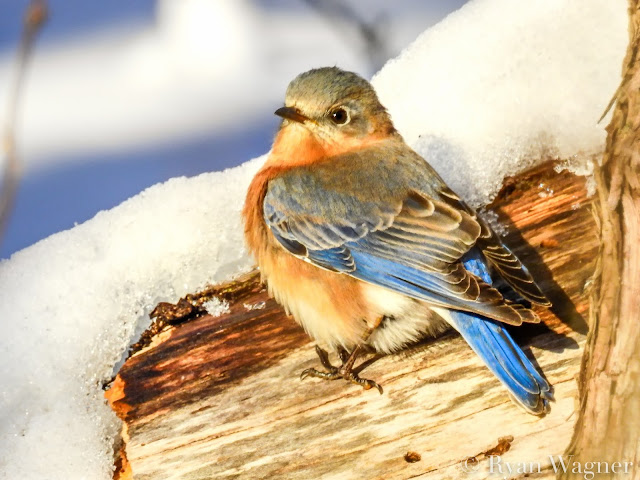
Some winter creatures make no efforts to conceal themselves.  The chipper bluebirds are always a welcome sight.  Males display the most brilliant colors, while the females are a dapper shade of gray and blue.  Finding the open fields and woods at The Ridges to their liking, my little flock of bluebirds have chosen to stick around for the winter months.  In spring, spotting just one of these elegant birds would mean that a dozen or more of the royal blue thrushes would soon be flitting through the trees all around me.  Now in late January, all but a handful have migrated south.

Bluebirds fly remarkably low, gleaning insects from the ground and popping up in nearby branches to ponder my presence with a slight tilt of the head.  They have developed a fondness for human habitation wherever we provide them with nest boxes and open space. I delight in their company; they have such character.

Field Life
Knowing the local birds makes a silent walk along the trails akin to visiting an old friend.  If the woods appear empty at first glance, simply stop and wait.  The birds will quickly reveal their winter activities, twittering joyously as they squabble over seeds.  No winter resident is more striking than a male northern cardinal (Cardinalis cardinalis).  These familiar birds (the state bird of Ohio) can be found in abundance even on campus.  That thick bill is used to crack their favorite treats: seeds, nuts, and berries.  Cardinals do not molt into dull winter plumage, making their red splendor all the more inviting during this bleak time of the year.  When temperatures drop, cardinals form large flocks with other bird species including junkos, titmice, and sparrows.

Field Life
Weighing less than a hummingbird, the golden-crowned kinglet (Regulus satrapa) is truly a tiny creature.  These birds fearlessly hop about the frozen understory, uttering a tree-tsee-tsee call as they check every nook and cranny for hidden insect larvae.  These migrants from the high arctic spend the breeding season in Canada's boreal forests and the winter in our own backyards. Despite their small size, golden-crowned kinglets can survive temperatures well below 0 degrees Fahrenheit.  On truly frigid nights, kinglets huddle together for warmth under the swooping branches of large conifers. When working a particular tree for their insect prey, these birds are in perpetual motion—often breaking off to zip after one another as they compete for the best feeding spots.


Field Life
To appreciate the richness of the winter woods, one must leave behind the warm confines of home.  Let nature's frozen splendor wash over you and guide you along her trails.  They don't have to be man-made, deer footprints will do.  Winter is a time to take stock, to regroup, to think and reflect.  Her frozen earth and icy ponds hold an energy—spring thaw is never far away.  

Enjoy the little things before they are gone. 

Monday, December 11, 2017

Ohio Wildlife Legacy Stamp 2018

I am pleased to announce that my photograph of an eastern garter snake was chosen to be the Ohio Wildlife Legacy Stamp for 2018.  It will be featured on the ODNR website.  Sales for the stamp begin March 1, 2018.  

I never in my wildest dreams expected to write this post.  It all started one afternoon in late August 2017. I happened to be checking my Facebook feed (I know, I know); social media is often cast in a negative light, but for a wildlife enthusiasts like myself, it can be a god-send.  The group Herping Ohio has been one of my favorites for a while.  This Facebook group is an amazing collection of nearly 1,000 members interested in Ohio’s native reptiles and amphibians.  It unites both newcomers to the world of herps as well as seasoned veterans.  I have had the good fortune of interacting with many of its members both online and in person.  Scrolling through the group’s feed is a great way learn what others have seen around the state. It provides a necessary tool for building connections with other like-minded and passionate herpetologists.

Ryan Wagner
I often start my mornings checking what ‘the gang’ has posted.  Everything from hog-nosed snakes to spadefoot toads to timber rattlesnakes have appeared in the lineup at one time or another.  It is a delight to share in the experience of discovery—if only through a screen.  Seeing other herpers spending their weekends out in the sweltering heat and pelting rain motivates me to get off the computer and get outside.  There are creatures to be found and photos to share.  Images span from slightly out-of-focus iPhone shots to professional grade photography.  In the end, it isn't the quality of the photo that matters, it’s the photo’s subject.  I often scroll through at high speed, reassuring myself that I can identify Ohio’s different herps at a glance.  

One Herping Ohio member shared a link that happened to catch my attention.  Without a photo of some interesting animal, I normally would have scrolled right past; but something about the post gave me pause. The link redirected to the Ohio Division of Natural Resources website with a short description above.


Field Life
The original shot.
The caption read, “The subject of the 2017 Photo Contest is a native Ohio Snake!  The winning photo will be featured on the 2018 Ohio Wildlife Legacy Stamp.”  Had the contest subject been any other group of vertebrates I would have kept scrolling.  I would stand no chance in a bird photography competition.  It’s not that I don't like to photograph birds (in fact, I spend a ridiculous amount of my free time trying to chase down unusual bird species), it’s that everyone likes to photograph birds.  Thousands of Ohio birders (with much fancier cameras than my own) would quickly outcompete my best shots.

A snake contest, however, now that was interesting.  There are far less people who spend their time trying to photograph reptiles and amphibians compared to their avian counterparts.  For reasons I have never fully understood, herps do not hold the same appeal as twittering songbirds in the glaring eyes of the public.  I have spent much of my life trying to destigmatize the reputations of reptiles and amphibians.  In this case, however, Ophidiophobia would work in my favor.  


Eastern Garter Snake
Another angle of the garter.

If initial fear isn't enough to scare off would-be photographers, getting down and dirty with a snake will often do the trick.  Snakes squirm, musk, and bite, often making for an unnatural shot and an unpleasant experience.  Some snakes can grow quite large and are difficult to corral into a suitable pose.  Others, like the pit vipers, can be downright dangerous.  Snakes are cryptic and flighty creatures, difficult to spot among the leaf litter and quick to disappear at the first sign of inquire.  They are a photographer’s worst nightmare in many aspects.

Luck would have it that at the time of this contest I would be in a unique position to photograph the diversity of Ohio snakes.  Working as a field tech on a box turtle study, most of my waking hours were spent in the woods.  My camera was perpetually slung around my neck—easy access in case a speedy racer (or my mythical ratsnake) appeared.  After photographing dozens of snakes that summer, I hoped one of my shots would be suitable.  I sorted through copperheads, foxsnakes, earthsnakes, and ring-neckeds.  The image I finally settled on was of an eastern gartersnake (Thamnophis sirtalis sirtalis).

Field Life
Screenshot courtesy of ODNR.
I stumbled upon the snake in question one summer evening while out turtle tracking.  Stretched out like a branch on the forest floor, another field tech had stepped right over the frozen serpent without even realizing it.  Garters are a common species, and are infamously nippy and smelly when caught.  I am usually satisfied admiring them from a distance.  On a whim, I decided to catch the little guy and take a few photographs.

The garter was a healthy sized adult with a stunning yellow face and flanks.  Its dorsal stripes were broken up into black and blue checkerboard striations.  As I picked the snake up, it whipped around to glare defiantly at me.  I placed the little garter among the leaf litter where it coiled and tongue flicked.  I had just a few moments for photos before I had to return to work.  I never imagined how nicely the shots would turn out.  

Field Life
Screenshot courtesy of ODNR.
Editing that night, I loved the way the snake’s colors popped on screen.  A yellow and blue body contrasted nicely with the snake’s sharp, blood-red tongue tinged with black.  Its eyes held an intense gaze fixed on my hand (out of frame) in front of it.  As the field season progressed, this image became buried beneath hundreds of others.  It only resurfaced when I began looking for the perfect shot to enter in the stamp contest.  

The Ohio Wildlife Legacy Stamp contest is an annual event featuring a different native Ohio creature each year (next year 2019 the subject will be Ohio owls).  These commemorative stamps are $15 with $14 out of every purchase going directly to conservation efforts (none of this money goes to me).  The proceeds support habitat restoration, keeping common species common, endangered and threatened native species, as well as education and research projects.  You can see and purchase the stamps HERE.  

As the contest rules instructed, I needed to print and mount my photo.  Being a college student with few art supplies and less loose cash, I recruited my mother and aunt to help me with the project.  Those two never shied away from a creative challenge.  When I was a kid, the three of us would spend days working on the various art projects I would dream up.  No endeavor was too mighty; my mom once spent over half a year constructing life-size paper mache coral reefs for my senior after-prom.  As kids, my aunt would design intricate halloween costumes for me and my brothers.

The three of us got straight to work, printing photos, buying supplies, measuring frames, and filling out application sheets.  We had a blast.  I never would have stood a chance without their help.  After submitting the photo, the wait began.  I didn't want to to get my hopes up, so I got on with class work (the homework of a biology student never seems to end).  

Field Life
A few months into the semester, I received a call from Tim Daniel, a professional wildlife photographer for the ODNR.  It took me a moment to realize what he was calling about.  I was flabbergasted to here that my little eastern garter snake had won!  “It was a gorgeous photo and will make a beautiful stamp,” Tim told me.  It made my day.  I immediately called home to tell everyone the good news.  

I am incredibly honored that my photo was chosen for the stamp.  Knowing that my little garter will help fund conservation efforts is extremely gratifying.  My endless thanks go to my friends and family who have put up with my reptilian obsession over the years.  I couldn't have done this without your help.

My advisor Dr. Viorel Popescu was nice enough to write a short article about my stamp for Ohio University.  Check it out HERE!

More Articles