Showing posts with label Southern Ohio. Show all posts

Tuesday, April 2, 2019

The Salamander Trifecta

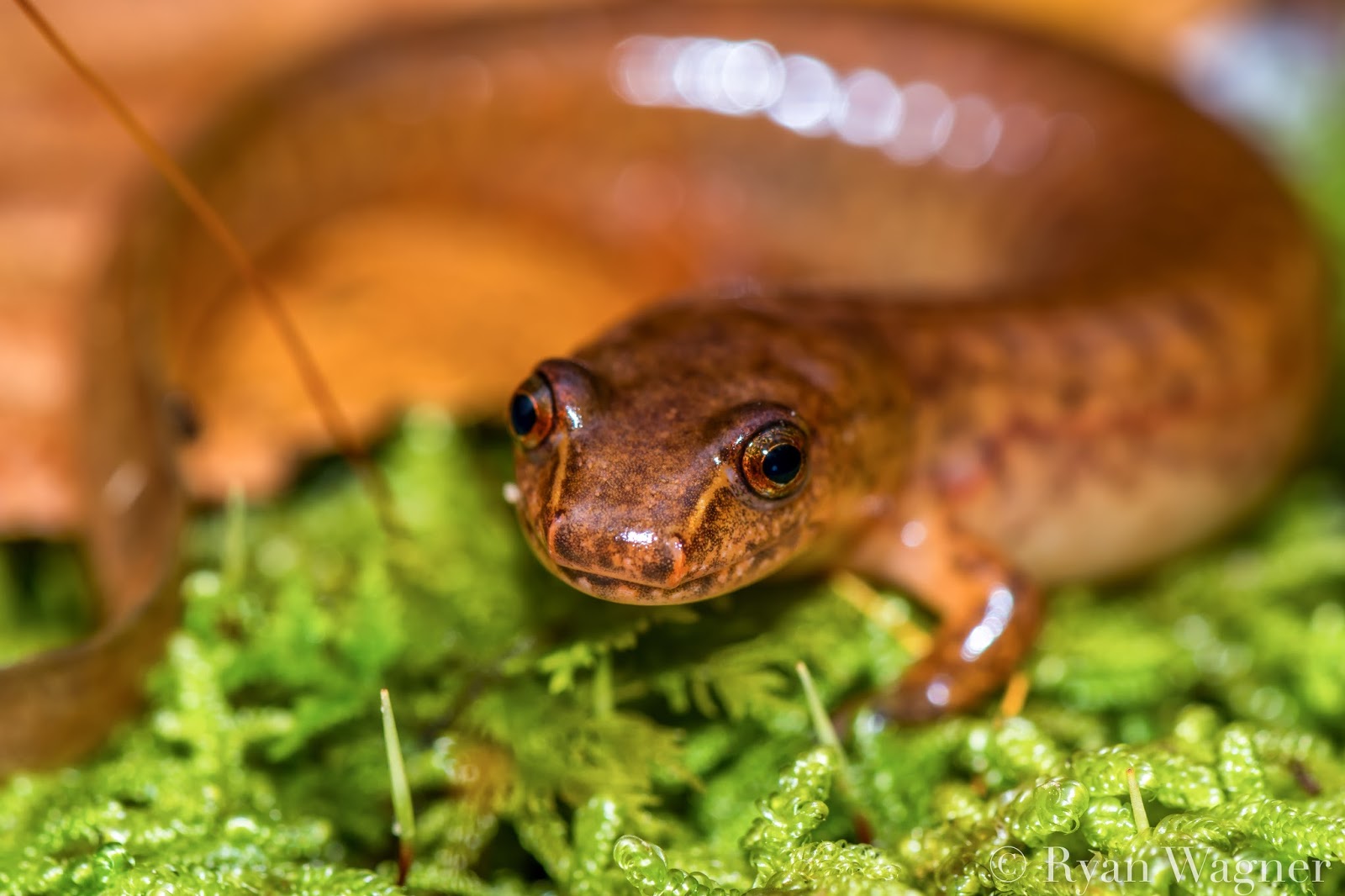
Mud Red Spring Salamander Ohio
The Salamander Trifecta (Back left: Kentucky Spring, back right: Midland Mud, front: Northern Red).
Spring break in Ohio (a luxury of us students) is usually hit or miss when it comes to the weather.  Some years bring a little taste of summer, others leave us snowed in for the week.  Usually there is at least one rainy night that peaks above 40 degrees.  That’s when the salamanders wake up.  By mid-March, ambystomids, or mole salamanders, begin their nocturnal migrations toward breeding pools by the hundreds.  Soon, every temporary rut with ample water will be chocked with eggs.  Plethodontids, or lungless salamanders, start to move out from their underground springs and rock crevices where they have spent the winter.  Larvae that have survived their second or third year (depending on the species) will soon metamorphose into adults.  

I’m not immune to the seasonal cues that tell dormant creatures it’s time to move.  As soon as the ground thaws (and sometimes before), you’ll find me clambering across Ohio’s streams and ravines in search of the year’s first herps.  Spring break is no time to relax when there is wildlife to be found.

Herping Adventures in Ohio
A Northern Ravine Salamander.
My fellow herper and OU student, Aaron Crank, and I decided to meet up halfway through the week to do some hiking.  When it comes to herping in Ohio, Aaron is the one to beat.  He reminds me of a young Carl Brune.  When driving between locations, he was constantly pointing out facts about the species in the area, what he has found and where, and what he hopes to spend more time looking for.  Just passed over an indistinct bridge? Now we’re in rattlesnake territory.  See that murky stream? Great mudpuppy spot.  I can’t help but feel a bit out of my league when in the field with Aaron.  I’m certain that sooner, rather than later, the name Crank is going to start popping up on most of the herp research projects in Ohio.  Lipps, Wynn, Davis, Pfingsten, etc.—the big names in Ohio herpetology—are sure to get a run for their money.

I have had the pleasure of herping with Aaron on a few previous occasions, searching for Kirtland’s Snakes and Small-mouthed salamanders.  Now that Aaron has transferred to Ohio University to study Biology, I hope our adventures to find Ohio’s rarest herps have only just begun.


Stories about salamanders in Ohio
Spotted Salamander.

As I have journeyed across Ohio (and beyond), I have encountered far more species than I ever hoped to find.  Some, I was lucky enough to stumble upon by shear luck (like my hog-nosed snake), others I’ve repeatedly targeted with only marginal success (Kentucky springs).  There is one pair of plethodontid salamanders that I have searched for dozens of times without any luck: the Pseudotritons.  

The northern red salamander (Pseudotriton ruber) and the midland mud salamander (Pseudotriton montanus diastictus) have been at the top of my list for years now.  I’ve found all sizes of their larvae with Carl, but not a single adult.  To make matters worse, these salamanders have the peculiar habit of turning up where you’d least expect them.  I’ll search the perfect habitat for months and find nothing but two-lined salamanders, then I’ll hear about someone who turned up a northern red under a stone fire pit or on their paved driveway.

Reds and muds are similar in appearance; both grow to be over six inches in length and posses a bright red body dotted with black spots.  Northern reds are stockier, with a distinct, horizontal stripe running though their golden, yellow iris.  Muds, meanwhile, are longer and sleeker with a blunt, almost pug-like snout and a brown iris (with no distinct eye stripe).


Herping Adventure stories for kids and adults
Four-toed Salamander.
Both species commonly inhabit streams and the adjacent stagnant pools separate from the main stream body.  Reds are typically found in aerated headwater streams, but can venture a significant distance from the nearest water source in summer.  Muds are tied more closely to moisture, and inhabit only lowland streams and seeps (occasional alongside the more versatile northern reds).

Reds and muds are distributed in a similar pattern across the eastern US, but the midland (P. m. diastictus—the subspecies native to Ohio), is only found in a disjunct population from southern Ohio to Tennessee.  In Ohio, Muds are documented from just 10 southern counties and are listed as state threatened.   

In the right habitat, adult and larval reds and muds can be found throughout the year.  But due to their general dependence on water, they can be quite challenging to find once their springs or pools dry up.  These salamanders are able to retreat deep underground, following the receding water.  This is where they mate and lay their eggs.  No one has ever observed a wild Pseudotriton nest in Ohio.  The life history and habits of these salamanders are so mysterious that we know very little about them.

Adventures with Salamanders in southern Ohio
Kentucky Spring Salamander.
Growing up in the middle of their joint range, Aaron knows these salamanders better than most.  We set off for Pseudotriton country before sunrise, eager to see what creatures our search would reveal.  

The first two stops of the day brought us to healthy-looking streams where Aaron had turned up midland muds and northern reds in the past.  Even where they are present, these species make you work for it. We carefully flipped countless logs and stones and dip netted each leaf-clogged pool.  We were able to uncover dozens of northern dusky salamanders, northern ravine salamanders, and even a lone spotted salamander.  Even more perplexing than not finding a Pseudotriton (adult or larvae) was the absence of the much more abundant Kentucky spring salamander (Gyrinophilus porphyriticus duryi).

I've found just three of these unique subspecies of spring salamander in my life.  According to Aaron, they can be thick on the ground in the right spots.  By the time we had searched our second stream system without a single duryi, Aaron was scratching his head in confusion.  I was beginning to worry I had brought my bad luck (something I'm famous for among my herper friends).  On our way out, Aaron flipped a four-toed salamander (Hemidactylium scutatum).  These salamanders typically breed later in the season (April-May).  This was likely a male that had arrived early at the breeding grounds.  It was a nice find, but our three target salamanders remained discouragingly elusive.  


Ryan Wagner and Aaron Crank Salamander Find
Northern Red Salamander.
Aaron had one last spot for us to check.  Third times the charm.  I pulled to a stop in front of a vehicle gate and we stepped out into a wide, mowed field that sloped up to meet a large reservoir.  This was his most tried and true location.  If we were going to find any of our target species, it was going to be here.  

We walked along an exposed creek that flowed out from an underground seepage.  Its margins had been completely cleared of vegetation and its shallow, rockless water was stained a deep, sickly orange from the iron leaching up from below.  Compared to the isolated and more pristine springs and streams we had searched early in the day, this looked like the last place a salamander would want to live.  Unconvinced, but committed to the search, I flipped the first log we came to.  Underneath was a healthy, larval mud salamander.  Aaron and I breathed a sigh of relief.  While not the adult we had come to look for, we could at least say, “we found a montanus.”  We snapped a voucher photo as proof, and headed for the end of the stream where the water pooled in a muddy basin.  

Ryan Wagner and Aaron Crank herping ohio
Northern Red Salamander.
Here, things looked more inviting.  Several large, moss-covered logs lay scattered in the muddy water.  This was prime pseudotriton habitat if I’d ever seen it.  Before we began, I set my pack on the bank.  I didn't want anything slowing me down if I had to make a quick capture.  I felt my boots sink up to my ankles as I position myself in front of one of the largest logs.  Anything might be hiding below—or nothing.  I crouched, gripped the sturdiest part of the decaying wood, and rolled the stump towards me.

Stretched out beneath was a whopper of a Kentucky spring salamander.  Heart racing, I shouted to Aaron what I had discovered as I wrangled the slippery, red-orange amphibian into my net.  Now things were getting good!  I set my net down carefully so as not to provide the feisty spring with a quick escape.  I turned to a slightly smaller log next the the first and rolled it over.

As I was just about to shift the log back into place, my brain registered something sticking out of a hole near the base of the log.  Before I could process what I had found, my hand and fingers had plucked the reddish object from its burrow.  This was my northern red salamander, and it was massive, even larger than the Kentucky spring I had just flipped.  Its six inch, chunky body was a deep red, speckled with well-defined, black spots, and its fat rudder of a tail was covered in scars.  This was an old salamander.


Ohio salmanders
Midland Mud Salamander.
Aaron shifted his weight in the muck, leaning towards a third log.  “Watch the mud be under this one,” he said, only half joking.  As I looked down at my net in disbelief, I could hardly feel surprised when he lifted a small, tomato-red salamander into view and said “here it is.”  My adrenaline was already at its peak.  All this remarkable, little salamander could do was add a numb spluttering sensation as a gawked into the distance at nothing in particular.  We had done it.  We had found all three of our target species under three consecutive logs in under three minutes.  

Aaron brought over the midland mud and placed it in the leaves next to the northern red and Kentucky spring.  “Well,” he said, “that’s our salamander trifecta.”  I half expected some kind of cosmic portal to open up under our feet.

How to find Salamanders in Ohio
Midland Mud Salamander.
I have scarcely heard of another encounter like the one we had that day.  Aaron has seen the “salamander trifecta,” once before, but spread out across a day of intensive searching.  Neither of us had expected such luck at the very last stop.  If you’re a fellow herper, you might be thinking ‘no one is that lucky.’  A few weeks have passed, and I’m still expecting to wake up from an overindulgent dream.  Finding a single one of those species would have made the trip.  A red or a mud would have been the find of the spring (maybe even the year).  All three at once? Now that’s one for the record books.

Edit 5/5/19:
In the time since I wrote this post, as many as ten different people have search this seepage.  The mud was tromped through, leaving deep boot prints, the moss was torn off and strewn about, and the logs were left in disarray.  Several two-lined salamanders, dusky salamanders, and at least one larval mud salamander were killed.  There were no live psuedotritons to be found.  People who "herp" without respect for these living creatures are not herpers.  Conservation and protection of these misunderstood animals needs to be at the forefront of our efforts.  One person herping the wrong way is a threat to all of us pursuing this fascination legitimately.  It is up to us as a community to condemn this kind of behavior and encourage positive practices going forward.  

RBW

Monday, December 4, 2017

Springs in the Fall

Field Life
The late fall air carried a brisk urgency that comes with the approaching winter months.  A deep breath of the crisp autumn air seemed to sharpen my senses and sent a shiver of goosebumps down my spine. One good rainy or windy day, and the foliage would be gone, leaving the trees as bare, skeletal fingers reaching towards the sky.  With its burst of colors and scents, fall is possibly my favorite season.  Like spring, there is a sense of necessity.  Animals are on the move, each species pursuing a different chapter in their lives.  For many, including reptiles and amphibians, fall is a storm before the calm.  The waining temperatures provide the last opportunities to feed, mate, and find overwintering sites.  There is a brief period of activity before they mysteriously disappear for nearly half the year.  With the season for snakes all but past, Carl and I were on the hunt for salamanders. 

Salamanders are a fickle group of herps.  With their moist skin and subterranean or aquatic habits, salamanders are much less dependent on ambient air temperatures.  This means they can remain active long after their reptilian kin have hunkered down for the winter.  Safely nestled under rocks and logs, they can still be discovered even once the icy chill has taken hold. Carl and I hiked into the trees, along a bridal trail that brought us to the edge of a ravine.  The ravine was fed by a series of natural springs and seepages—the perfect conditions for our amphibious quarry.  

Carl had brought along a large dip net to sample the deeper parts of the stream.  Like shoveling snow from a driveway, he scooped up some of the leaf litter choking a stagnant, muddy pool.  Dumping the pile of leaves and sand onto the ground, we started sorting through its contents. As we reached the bottom of the pile, a little wormlike creature wriggled away.  We scooped the animal into a tupperware container filled with clear creek water.  Now free to move about naturally, the creature became very un-wormlike indeed.  

Field Life
A larval red salamander.

Like a tiny dragon, the creature pushed its elongate body through the water on four slim legs.  Two fishy eyes sat on the top of its large head, which was lined by bushy, finger-like projections.  This little water monster was in fact a larval salamander.  A northern red salamander (Pseudotriton ruber) to be precise, evident from the shape of its head and its distinct pattern of spots.  The feathery filaments that lined its neck were gills, allowing the larvae to live full time in the stream.  At around 4 inches in length, it would soon metamorphose into an adult and make the transition to land. 

Field Life
A larval spring salamander.
Carl tried the dip net again, this time coming up with another larval red and an adult northern dusky salamander (Desmognathus fuscus).  After snapping some photographs we released the salamanders back into the pool.  We continued down the creek, dip netting and gently flipping flat stones so as not to cloud the water and obscure what might lay below.  Under one stone we were able to corral a slightly larger larval salamander into our bucket.  Upon closer inspection, this salamander displayed a mottled pattern, more like the sandy stream bed.  Its longer “weiner dog” body and square snout made it clear this was something different—a larval northern spring salamander (Gyrinophilus porphyriticus).  Catching the larvae was fascinating, but now I had my heart set on an adult.

Reptiles and Amphibians
Adult red and spring salamanders are not common finds.  Like most of Ohio’s salamanders, the adults are typically more terrestrial.  In the interest of time and efficiency, we focused on the “good rocks.”  A “good rock” is less a physical descriptor and more a personal feeling.  Any rock can be a “good rock,” just as long as it strikes you as something a salamander might like to hide under.  

There is some method to this madness.  Salamanders like to wedge themselves as tightly as they can under cover where predators cannot easily reach them.  Large, flat rocks provide ample room to squeeze under, making them particularly appealing to amphibians (and to amphibian searchers).  Stones stacked on top of one another with tight gaps in between are particularly good spots to check.  It is a bewildering fact that “good rock” often yields nothing but sediment.  I lifted one particularly nice stone slab revealing the perfect gap for a salamander—but no dice. “That should have had something,” Carl commented, knowing the feeling all too well.

Field Life

Usually sacrificed with adulthood, the childhood instinct to flip stones is something herpers never fully outgrow.  This quirk of stopping to check below every piece of cover can become (to my amusement) quite irksome to fellow hikers who wouldn't look twice at a lovely flat rock.  Stones are like potato chips, you can never flip just one—it's addictive.  The odds of discovery naturally increase the more objects there are to check.  Experience brings a sense of what looks right, making the “good” rocks start to stand out.  It should be noted that one of the most important rules of rick flipping is to return the rock to its original position.  This minimizes damage to microhabitats; after all, a lot more than just salamanders rely on stones to survive. 

I was born with the rock flipping gene; making the capture, however, was something I had to learn.  As a boy, I was often too slow or too shy to grab whatever slimy or scaly creature I had discovered.  When it was crunch time, I usually hesitated, allowing the animal to inevitably escape.  Luckily, I wasn't deterred.  The illusive nature of herps only added to my childhood fascination.   

Field LifeAs Carl and I continued along the creek bed, I flipped a large, mossy stone sitting among a pile of leaves on the bank.  A fat, rudder of a tail wriggled for cover.  I had the creature in hand before my brain could process spring salamander.  Jittery with adrenaline, I called out, “got one!”  

Our specimen was around 5 inches in length, the biggest sallie so far, but still small by spring standards.  I was sunned when I first learned that spring salamanders could grow to around 9 inches in length.  Springs are some of the most aquatic plethodontid (lungless) salamanders in Ohio. Adults can be found under cover (as ours was) or among their larvae in leaf-clogged, predatory fish-free streams.  On warm, rainy nights, when slimy creatures venture away from their daytime hide-aways, spring salamanders can be found by road cruising.  


There are two spring salamander subspecies that occur in Ohio: the northern spring (G.p.porphyriticus) and the Kentucky spring (G.p.duryi).  Both races are thinly scattered throughout forested ravine bottoms in southeastern Ohio.  Breeding takes place in underground springs during the winter, making this species even more difficult to find.

Unwary herpers be warned.  Place a spring salamander in a container with a smaller salamander species, and you will end up with one very fat porphyriticus.  Springs are infamous for being salamander hunters, often feeding on northern duskies and two-lineds (Eurycea bislineata) as well as invertebrates.  They can even be cannibalistic, chowing down on small and newly metamorphosed members of their own species.

Field LifeAs I placed the spring salamander on its mossy stone for photographs, I was still shaking with excitement.  I am always surprised when I actually find the fabled creature I am searching for. Photographs and species accounts are no substitute for the real thing.

Our individual was a soft cream color—Carl considered it “ugly” for a spring.  I couldn't agree. With their large muscular tails, springs are energetic, nimble salamanders (as I would soon learn). As I repositioned the salamander, it instinctively dove for the water.  Trying to grapple with a wriggling salamander is like trying to hold onto a lubed up fishing lure that is being rapidly reeled away.  It felt like trying to regain control of a hacky sack in the last seconds before it is inevitably kicked out of reach.  The salamander plopped into the water and disappeared into a tangle of leaves.  I stood up with nothing to show for my efforts except a muddy pair of knees and a two handfuls of viscous slime.

Field Life
Loss aside, I ended up flipping three more springs, one in each of the four ravines we would hike that day.  Two were a stunning salmon-tone, while the fourth was a silvery, gun-metal gray.  The trip had brought us to some gorgeous locations.  Huge rock walls towered over us with waterfalls cascading hundreds of feet to patter against boulders and babbling brooks.  I left with another species to check off my list and a camera full of photos (around 350!).

I often wonder where the time goes.  With another herping season drawing to a close, I am forced to hunker down into what might be my own winter hibernaculum.  Like the snakes and salamanders that have enchanted me, I find myself waiting for vernal warmth to return. Increasingly frigid temperatures and waining daylight make it a challenge to get outside and explore.   I must constantly remind myself that even on days that feel still and lifeless, there is something, somewhere to be discovered.  Nature always has a story to tell; with luck, I hope to find those stories.


Field Life

Tuesday, October 10, 2017

No Ordinary Black Snake

Read part one HERE

The black snake lay stretched across the pavement, slinking in the direction of the woods.  Had we been a minute later, we would have missed it completely.  Carl slammed on the brakes and we both leapt from our seats.  I raced around the passenger side, my view of the snake obscured by the truck’s hood.

When I heard Carl make the ID, my heart stopped.  “Hog-nosed!” he shouted from the opposite side of the vehicle.  I skidded to a halt.  “Oh my goodness,” I stammered in stunned elation.  This was too good to be true; was I dreaming?  First green salamanders and now my long sought-after lifer eastern hog-nosed snake!  I had wanted to see a hog-nosed ever since I first read about them nearly ten years ago in my reptiles of Ohio field guide.  During my teenage years, posters depicting Ohio’s native snakes decorated my bedroom walls.  The hog-nosed, with its peculiar upturned snout, always drew my eye and captured my imagination.  I never believed I would actually get to see one.

Eastern Hog-nosed Snake
The hog-nosed snake (Heterodon platirhinoswas a sight to behold—three feet long, jet black, and hissing.  Her head was flattened out in the hog-nosed’s characteristic, cobra-esque defense display.  As we inched closer she reared up, showing us the broad side of her neck and seething with deep, rattling sibilations.  The snake's mouth was elongated into a wide grin; with those unblinking eyes, her expression had the intensity of a madman.  As we got closer, the snake’s apparent rage only increased.  We needed to move the furious serpent off the road; other cars would soon be upon us.

Eastern Hog-nosed Snake
To the reader, if you have never heard of the hog-nosed snake you might be quite surprised at what comes next.  Gingerly, I picked up the pseudo-cobra.  She continued to hiss furiously, but never attempted to strike.  Hog-nosed snakes are all bluff.  They put on a show to scare off would-be predators by appearing big, confident, and dangerous.  Hog-noseds are in fact completely harmless.  They are toad hunters, with fangs in the rear of the mouth used to pop the inflated bodies of their warty prey.  These fangs contain a mild amphibian toxin, but this poses no real threat to humans.  

For a hog-nosed to envenomate you, it must first bite (which they are not typically inclined to do—unless you smell like a toad).  Hog-nosed snakes may strike when encountered; this is usually a feint.  If the snake were to make contact, its nose would just glance off your body, mouth clamped tightly shut.  If the snake does somehow bite (this is only likely during an accidental feeding response from a captive snake), the recipient would have to allow the snake to hang on and chew.  Chewing slowly works the back fangs and mild venom into the wound.  Most people who are envenomated allowed the snake to chew because they thought “it was cute.”  Even if all this comes to fruition, the bite shouldn't be any worse than a bee sting (though like a bee sting, some people may have an allergic reaction—making a bite more serious).  


eastern hog-nosed snake

As I held the rapidly contracting and expanding body of the hissing hog, a pickup pulled up beside us.  Two county sheriffs looked out at me and my apparent cobra with stunned curiosity. "That's no ordinary black snake," one of them observed.  His tone was somewhere between horror and reverence.  We explained to them that the snake wasn't dangerous and that we were moving it off the road so it wouldn't be hit.  They seemed intrigued by this bizarre and apparently ferocious creature living in their woods that they had never seen or heard of before.  They drove off likely thinking, “Those guys are crazy.”

We placed the hognosed at the edge of the road for a few more photos.  When we heard the engine of another car approaching, I grabbed the snake again.  This time, I squeezed her tail just a bit too hard—a fact I would soon come to regret.  A shudder ran through the snake’s body. Suddenly, the hog began to thrash about violently as though it had been shot.  Epileptic seizures gripped the hog-nosed for several seconds.  Finally, its bowels discharged and the snake hung limp.  “So much for photographs,” Carl said with disappointment.

Eastern Hog-nosed Snake
Hog-nosed snakes play dead when feeling threatened.
Surprised?  This is the second act in the hog-nosed snake’s playbook.  If pretending to be big and bad isn't sufficient to scare the threat away, the hog-nosed will play dead.  This two-part performance has earned hog-noseds the affectionate title of “the drama queens of the snake world.”  Hog-nosed snakes take playing dead to a whole new level.  After her Shakespearean death scene, our hog rolled onto her back, gaped, and let her tongue hang out.  Defecating on herself helped to give that final stinky touch.  Who would want to eat a dead snake that had been laying in the sun all day?  

There is one famous flaw to the hog-nosed snake’s death act.  I gently flipped the ‘dead’ snake onto her stomach, hoping to snap her out of it.  Instead of coming back to life, however, the hog just rolled over again.  There is no convincing a hog-nosed that a dead snake shouldn't be laying on its back.  I asked Carl if there was any chance we could wait out the hog’s performance to get some more pictures.  He assured me there was not. 

Eastern Hog-nosed Snake

Carl has seen around two dozen or so hog-nosed snakes in Ohio over the years.  Sadly, about half of those have been dead on the road.  “I have no formula for finding that species,” he explained to me when I inquired about hogs during one of our first trips.  When conditions are right, they might turn up.  Just what those conditions are, however, isn't quite clear.  Warm, cloudy days seem to be good for snake movement.  Today was one such day.  On our drive down, we stopped every few miles to inspect the bodies of recently road-killed snakes.  Herps were definitely out and about.

Once, Carl had the good fortune of flipping a cover board with two hog-nosed snakes under it!  Whatever it was about that day’s conditions had brought not one, but two hog-noseds to utilize his boards.  Does the great rarity with which they are seen mean hogs are sparse in Ohio?  Not so!  Hog-nosed snakes are likely much more common than we realize.  They occur in several counties along Lake Erie as well as the hill counties of southern Ohio.  It is the hog-nosed’s fossorial nature that makes them so mysterious.  Hog-nosed snakes are most commonly found where there is sandy soil.  That upturned snout allows them to dig for toads—their main source of food.  Much of a hog-nosed’s life is subterranean, out of sight of eager herpetologists. This was only the second live hog-nosed snake Carl had driven up on in nearly 15 years of searching.  

Eastern Hog-nosed Snake
I was honored to have seen an eastern hog-nosed snake in the wild.  Our female was a particularly large and stunning specimen.  Hog-noseds generally have a pattern of spots or blotches, with shades of peanut butter brown, tan, black, orange, and even brick red.  Our girl was completely melanistic—solid black except for a rim of white around her lips.  If we hadn't been in a hurry to get home, I would likely have spent the rest of the day with her. I released the still limp snake into the woods in the direction she had been heading.  As we drove away I expressed my disbelief at our find.  It didn't feel real.  "It'll hit you when you don't find another one for four years," Carl said knowingly.  I can only hope it won't take that long.

Monday, October 2, 2017

Green Eggs and Herps

I scanned my headlamp across the glittering surface of an enormous wall of lichen-covered sandstone.  I felt like a contortionist as I twisted my head in order to peer into every crack and dimple in the stone's face.  Eventually, I reached a long crevice that separated two of the immense rocky outcroppings.  The crevice was little more than an inch wide, and grew progressively tighter the farther back I looked.  My small headlamp illuminated different degrees of rock as I moved along, casting the surroundings into deep shadow.  All of a sudden, my light fell on the elongate body of an amphibian.  The salamander was small, only a few inches in length.  Its skin was covered in little, splotchy markings—but were they green markings?  I quickly turned off my light, not wanting to scare the creature away before I could be positive what it was.

Northern Slimy Salamander
A northern slimy salamander.
At that moment, I heard Carl’s muffled voice from the other side of the ridge top.  “I found one!”  he called.  I left my snake stick as a marker, and rushed to the rock face where he was searching.  “I didn't get a great look, but it’s a big one,” Carl said as he rummaged through his backpack for his camera equipment.  As he started snapping shots of the salamander, the flash revealed the creature’s glistening black-body and light colored markings.  The longer we looked, however, the more apparent it became that the makings were not in fact green, but white.  “It’s a slimy,” Carl corrected.  Plethodon glutinosus: not our green, but still an interesting find.  At several inches in length, it was the biggest northern slimy salamander I had ever seen.  

Carl and I had traveled down to southeastern Ohio to search for the state-endangered green salamander.  “Each of these ridges with exposed rock should have them,”  Carl explained, pointing out hotspots on his topographic map.  He had searched this location in past years with a 100% success rate.  I had looked for green salamanders once before with no luck.   Read about my adventure in The Henslow’s Sparrow and the Search for the Green Salamander.  This time, I felt good about our odds.

Green Salamander

Green salamanders are a curious species.  They occur in Ohio at the extreme northern tip of their range, only extending into a few southern most counties.  They inhabit the crevices of limestone and sandstone cliffs in forested areas.  Often wedged deep within the rock’s pockmarked visage, the salamanders take some ingenuity to find.  

I led Carl back to the fissure where I had discovered the little, freckled salamander moments earlier.  He took one look with his flashlight and confirmed, “That’s exactly what we are looking for!  A green salamander!”  We sat hunched over for the next 20 minutes, angling our cameras so the flash would hit the salamander just right.  Photographing in such tight quarters is no easy task.  The salamander was small for a green.  At only a few inches in length, it was likely a hatchling from the previous year.  

Green Salamander
To finally have a green salamander at hand was a relief.  Ever since my efforts had been thwarted a few months prior, I had been counting down the days until I could hunt for them again.  On this search, I was determined to check every stretch of rock, even if it took all day. Finding our green turned out to be much easier than I had anticipated.  This was only the second series of rocks we had checked, and I found the little salamander just minutes into our search.  It sat parallel to the vertical rock wall, calmly ignoring my light.  Some green salamanders grow nervous when illuminated, retreating deeper into the rock.  Its body was purple-ish black with yellow-green markings similar to the lichens that cover its abode.  It would have been easy to overlook.


Green Salamander Habitat.
As we hiked on, we continued to scan each large stretch of rock for salamanders.  “The tiny cracks that reach deep into the stone are good places to check,” Carl explained.  Salamanders (and most herps for that matter) tend to hide in spaces just big enough for their own bodies to fit.  This keeps them hidden and prevents larger predators from entering.  At most of the holes I examined, I was met with the bizarre, curled body of a large species of cave cricket.  Below overhangs of stone, where sandy soil had been deposited, we found the funnel traps of ant lions (small larval insects that dig pits to trap prey).  As we came to one rounded slab of stone, we hit pay dirt.  Along a section that stretched several meters, we found four more small green salamanders!

Green Salamander
As we photographed and marveled at our luck, Carl made another fascinating discovery.  Hanging from the ceiling of one rock crevice were several green salamander eggs!  Green salamander mothers will remain with their clutch until they hatch.  The mother was likely hidden behind the egg mass, out of our line of sight.  Green eggs usually hatch by September, so finding a clutch was a real surprise.  Green salamanders skip the tadpole stage (direct development) and emerge from eggs as miniature adults.  The hatchlings may remain with their mother for a few weeks and reach sexual maturity by year three.


Green Salamander eggs
Green salamander eggs.
We had found our target species for the day: the rare and beautiful green salamander. couldn't have been happier.  Across their limited Ohio range, green salamanders likely occur in most areas with suitable sandstone cliffs.  Much of their habitat is hidden away on private lands, limiting the number of populations herpetologists can discover.  The rough, rocky terrain that suits these amphibians will hopefully protect their homes from being demolished or developed.  

Green Salamander

As we were preparing to head home, Carl decided to drive the final stretch of road we were parked along.  The day was warm and cloudyperfect for reptile movement.  The paved road was a light, uniform gray.  Anything on it would jump out like a sore thumb.  As we crept along, the asphalt seemed to radiate with potential.  We both saw the snake at the same moment.  

I never would have guessed what we found.

Thursday, September 14, 2017

Baby Season

Rainclouds congregated overhead, tickling the back of my neck with a dusting of precipitation.  The light mist added a thin haze to the landscape, like noise in a photograph.  Compared with the dog-days of summer to which I had grown accustomed during field season, the mid-60 degree September morning felt downright chilly.  Rainstorms blown in from Hurricane Harvey had plunged Ohio’s weather into what felt like late fall.  Carl Brune and I were back in southern Ohio, herping our way through Scioto, Lawrence, and Gallia counties (read our previous adventure HERE).

Rough Greensnake
We had stopped to check two sets of boards along the road, coming up empty at both.  At the third stop, Carl had a surprise.  He pulled a Tupperware container from the backseat and handed it to me.  Inside, I could see the outlines of four wriggling, blueish-green creatures.  Each was only a few inches in length, and scarcely wider than a blade of grass.  “Baby rough greensnakes!” I exclaimed.  

Rough Greensnake
Carl had found the four snakes as eggs back in mid-July and had taken them home to incubate.  Seven weeks later, the mystery eggs had hatched, revealing their identity.  Over the years, Carl has hatched milksnakes, kingsnakes, and hognose snakes from eggs collected in the field.  Rough greensnakes were a first.  The little, teal noodles tumbled over each other as they tried to scale the vertical walls of their container.  I admired their shimmering, green scales and their oversized baby-snake eyes.


Five-lined Skink
A baby skink found below carpet.
For many of Ohio’s reptiles, baby season begins in July and lasts through August and September and into early October.  Eggs laid in spring and summer, or incubating within the bodies of livebearing species, are ready to hatch. “As many as half the snake population can be hatchlings in fall,” Carl explained.  From forest to garden, neonate herps start popping up everywhere.  Few newborn reptiles and amphibians receive parental care.  Some salamander and lizard species will guard their eggs until they hatch.  Newborn rattlesnakes often remain close to their mother for a few days to weeks.  Most herps, however, are left to fend for themselves from birth.

Eastern Fence Lizard
Baby fence lizard in situ.
Unlike mammals and birds, neonate reptiles are far from helpless.  Baby rattlesnakes are able to deliver a lethal bite from the moment they are born.  The shells of baby turtles quickly harden to serve their protective purpose.  Baby lizards are born running and ready to drop their tails at a moment's notice (called autonomy, many lizard species can detach the end of their tail when grabbed by a predator).  During the last few warm months of the year, hatchling reptiles begin life in a frenzied search for food and a place to overwinter.  Many will not survive, falling victim to predators, roads, and exposure.  Individuals that make it through their first year greatly increase their chances of survival.  Many large snakes can live into their 20s, while box turtles can reach 100+ years.  Young herps grow quickly, but for now, they’re the smallest kids on the block.

Rough Greensnake
After taking a few parting photographs, we placed the baby rough greensnakes under the same rock where they had been found as eggs.  “Live long and prosper,” Carl said as they slowly wriggled out of sight.  It was refreshing to release these newborn snakes.  Herpers often see as many dead—from road mortality and the like—as live reptiles.  Helping to head-start a few of the next generation felt meaningful—if only in a small way.

Rough Greensnake
There are two greensnake species native to Ohio: the rough green (Opheodrys aestivus) and smooth green (Opheodrys vernalis).  Rough greensnakes are the more plentiful of the two, but still not a common snake species to find.  I have yet to stumble upon a live one while out herping.  Carl estimates he has seen around 40 individuals over the years.  It is likely their secretive nature and excellent camouflage that make them so tough to find.  Greens are long and thin, reaching from 2 to 2 1/2 feet in length, and grow about as fat around as a pencil.  They are limited to around 10 counties in southern Ohio.  As the name suggests, the rough greensnake is rough in texture; each scale has a little ridge running down the center called a keel.  Their beautiful grass green exterior helps them to disappear among the foliage of trees, shrubs, and grapevines.  In death, the greensnake’s brilliant green coloration fades to a peculiar blue tone as the yellow pigments quickly break down.

Eastern Smooth Earthsnake
Earthsnake in situ below carpet.
We saw several other baby herps during our trip.  Hatchling five-lined skinks (Plestiodon fasciatus) scurried for cover as we lifted boards and carpets.  We also came across a baby eastern fence lizard (Sceloporus undulatus) basking on the side of a post.  I would likely have walked right by the little guy if Carl hadn't spotted him.  Under two slabs of carpet we discovered eastern smooth earthsnakes (Virginia valeriae) almost as small as our baby greensnakes, but fully grown adults.  The diversity of body shapes and sizes among snake species is stunning.  Read about some of Ohio’s small snakes HERE.

Reptiles aren't the only points of intrigue when traveling through southern Ohio.  As we drove up and down the back country roads we passed several old, abandoned structures.  Dilapidated barns have a certain beauty to them, standing like totems to the past.  Their wooden frames bow and fracture with age, sagging under the strain of growing vines and shrubs.  Slowly, nature’s tendrils work to reclaim the structures as her own.  


There is one building nestled away in the backwoods that will take nature some time to reclaim.  As we hiked, the exoskeleton of an enormous concrete factory loomed over the trees.  Its gray visage was weathered and stained with dark streaks.  Small trees burst from its now vacant windows like ear hair.  A stripe of rust stretched to the ground between the building’s giant concrete cylinders—the remains of a spiral staircase.  Below, we hiked across an open plateau in the middle of the forest.  The soil was artificially black and sandy from the coal that had been mined there.  This had once been a bustling company town, but now it was a forest.  A town of ghosts.  Most of the cover boards that had been scattered throughout the clearing had recently been burned or used for target practice—the only sign that other humans visited this post-apocalyptic scene.

Herping is always an adventure.  As I travel to find new and unexpected creatures, I often find myself in new and unexpected locations.  Each search is like entering a new world.  I am constantly asking myself, "what's next!?"  With so much to see, the life of a wildlife enthusiast is never boring.

More Articles