There is beauty in the stillness of a winter landscape. As if overnight, Autumn’s warm tapestry is transformed into dichromatic layers of black and white. The long, arching shadows of branches and vines contrast with the glittering snow and sky. Sounds become muffled, absorbed by the white hills of insulation and whipped away on the breeze. From frosted meadows to dense, tangled thickets, there is a hushed feeling of isolation—eery, yet somehow calming. Time stands still in the winter woods; a pause may only last a second, an hour, a year. A spell only broken by the crunching of ice under boots.
 |
| Winter Footprints... |
Truth be told, I meet winter with mixed emotions. All too often, I look past the beauty before me, imagining the warmth a few more months will bring. It’s easy to get caught up in this waiting game. I’ll go out when its warmer, or maybe when its sunnier. Time passes and I never stop to appreciate all that winter has to offer. I dream of days catching snakes, mornings of birdsong and activity, nights spotlighting salamanders and listening to the chirps of katydids. But this is only half the picture; nature doesn't stop once the reptiles have taken shelter and the warblers have migrated to southern climates. A whole host of characters, stories, and secrets are waiting to be shared with the persistent observer.
For the past several weeks, I have spent the evening hours at The Ridges, a research land lab owned by Ohio University (it’s also an old asylum, but more on that in a later post). The Ridges provide a diversity of habitats for many of Ohio’s winter residents. Last year, most of my spare time was spent hiking its trails and exploring the ravine bottoms and hilltops. Just a short walk from campus, The Ridges provide a welcome escape from the bustle and stress of college life. I am always surprised how few students use or even know about the ridges. I hardly ever see anyone else during my walks—just me and the birds.

The calmness of the woods is just an illusion, however. The creatures here live their lives as franticly as I live my own. Their winter chores can be watched silently from below as they gather food, hunt prey, chisel homes, and defend territories. This is a world I feel privileged to view, if only at a distance. Stepping off the brick road and onto the dirt path, I am greeted by the disapproving
chuck-chuck of a gray squirrel, its sharp scolding notes ringing in my ears.
As I trudge through the snow, it becomes painfully obvious how out of place I am among the trees. I can’t help but leave behind an arrow of footprints—a map of my movements across the blank landscape. The birds, meanwhile, leave nothing but feathery imprints as they whisk seeds from the trail and insects from beneath shelves of bark. All the creatures here are well aware of my presence, try as I might to mimic their stealth. I have come to accept that I will never be as covert as the trotting coyote or as mindful as the roosting owl.
Much of my time in the woods is spent seeking. The biologist in me is constantly trying to find some new curiosity to document and describe. There is always some behavior to witness first hand, or a species to identify in my field guide. Many of my most sublime moments in nature, however, have been spent without any set goal in mind. Allowing the twists in the trail, the whistling of birds, or the lengthening rays of late evening light to direct my wanderings have revealed what the hurried seeker would almost certainly miss.
This is a more spiritual side to viewing nature; a side I often neglect for the thrill of the search. This deep connection to the natural world is what got me hooked on wildlife as a boy. It’s what gets me up in the morning and makes me grin with anticipation every time I open my window blinds to reveal the trees awash in morning sunshine.
Hiking the same trail time and time again is never boring. If it is, I know I am not paying attention, for no two trips through the woods are ever the same. Getting to know a patch of wilderness allows an observer to feel in tune with the minute changes that each day brings. I like to notice the little things. A snapped branch from one day to the next helps key me in to the movements and behaviors of the woodland creatures. The chiseled bark around a small cavity could mean a woodpecker is taking up residence. A lone pellet in the snow might be the only clue that a great horned owl is hunting the fields by night. Signs of life all too easily overlooked.
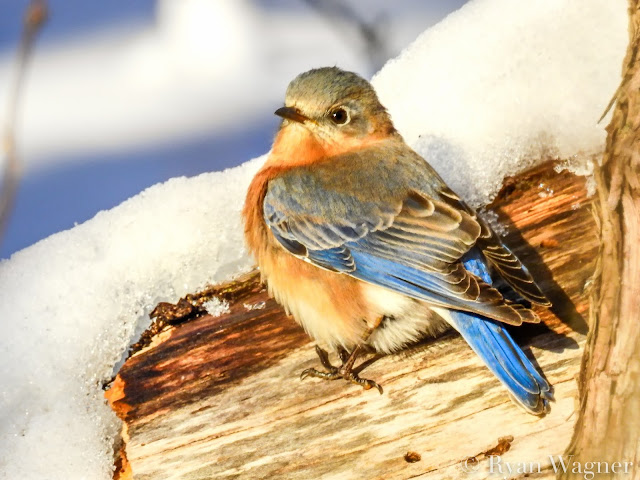
Some winter creatures make no efforts to conceal themselves. The chipper bluebirds are always a welcome sight. Males display the most brilliant colors, while the females are a dapper shade of gray and blue. Finding the open fields and woods at The Ridges to their liking, my little flock of bluebirds have chosen to stick around for the winter months. In spring, spotting just one of these elegant birds would mean that a dozen or more of the royal blue thrushes would soon be flitting through the trees all around me. Now in late January, all but a handful have migrated south.
Bluebirds fly remarkably low, gleaning insects from the ground and popping up in nearby branches to ponder my presence with a slight tilt of the head. They have developed a fondness for human habitation wherever we provide them with nest boxes and open space. I delight in their company; they have such character.

Knowing the local birds makes a silent walk along the trails akin to visiting an old friend. If the woods appear empty at first glance, simply stop and wait. The birds will quickly reveal their winter activities, twittering joyously as they squabble over seeds. No winter resident is more striking than a male northern cardinal (Cardinalis cardinalis). These familiar birds (the state bird of Ohio) can be found in abundance even on campus. That thick bill is used to crack their favorite treats: seeds, nuts, and berries. Cardinals do not molt into dull winter plumage, making their red splendor all the more inviting during this bleak time of the year. When temperatures drop, cardinals form large flocks with other bird species including junkos, titmice, and sparrows.
Weighing less than a hummingbird, the golden-crowned kinglet (Regulus satrapa) is truly a tiny creature. These birds fearlessly hop about the frozen understory, uttering a tree-tsee-tsee call as they check every nook and cranny for hidden insect larvae. These migrants from the high arctic spend the breeding season in Canada's boreal forests and the winter in our own backyards. Despite their small size, golden-crowned kinglets can survive temperatures well below 0 degrees Fahrenheit. On truly frigid nights, kinglets huddle together for warmth under the swooping branches of large conifers. When working a particular tree for their insect prey, these birds are in perpetual motion—often breaking off to zip after one another as they compete for the best feeding spots.
To appreciate the richness of the winter woods, one must leave behind the warm confines of home. Let nature's frozen splendor wash over you and guide you along her trails. They don't have to be man-made, deer footprints will do. Winter is a time to take stock, to regroup, to think and reflect. Her frozen earth and icy ponds hold an energy—spring thaw is never far away.
Enjoy the little things before they are gone.


