Showing posts with label Western Chorus Frog. Show all posts

Monday, December 3, 2018

Springs in the Fall 2: Kentuckies in Ohio

Part one here.

As I dropped the flattened stone I had been lifting back into place, Carl called out, “I’ve got one!” Looking up the creek, I saw Carl hunched over, a large stone slab balanced against his leg and arm.  Our hike was beginning to push the five hour marker, and we hadn't found so much as a red-backed salamander as a consolation prize.  My back and arms ached from the countless rocks I had lifted.  I had been nearly ready to give up; the day was just too warm and dry for amphibian activity.  Kentucky spring salamanders (Gyrinophilus porphyriticus duryi) might be common in cooler, wetter conditions, but today was clearly not favorable. We'd missed our best chance to find one, I had thought.  Call it pure luck or persistence, but our searching finally payed off. 
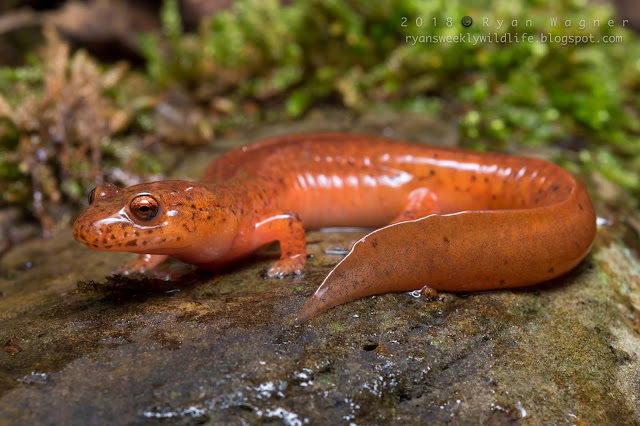

Spring salamander in Ohio
In the shallow depression where the stone had perviously lain, an underground spring trickled into a small, murky pool.  Just below the surface, sat the orange silhouette of a large salamander.  With Carl pinned against the rock, it was up to me to make the catch.  I moved deliberately, trying not to disturb the pool and scare the salamander back underground.  My hands shook from a mix adrenaline and exhaustion as I tried to cut off the salamanders exit.  It was an awkward fit, but I was able to wedge the end of my dip net below the pock-marked rock and the uneven, gravel riverbed.  If I could just get ahold of the salamander’s plump body, I’d be able to usher it into the net.  I plunged one hand into the water.  For a split second, I felt the slimy body of the salamander slide through my fingers.  Then it was gone.  

It’s fair to say I was aghast.  As I looked up in horror, Carl chuckled.  “That’s the way it goes sometimes with springs,” he said.  Our near success prompted another hour long search before we finally gave up.  That orange silhouette has haunted me ever since.  I can’t count the number of times I’ve played the scenario over in my head, imagining what I would do differently if I could have another chance.  


salmander stream Ohio
That was late spring 2018.  The dry, warm weather had pushed most of the Kentucky springs below ground.  All except for that fateful individual.  I would have to wait for fall before the pinkish-orange amphibians ventured back up to the surface.  Carl and I spent the summer hiking, searching for everything from rattlesnakes to racers, that one, lone Kentucky spring in the back of my mind all the while.

Spring salamander in OhioThe Kentucky spring's cousin, the northern spring salamander (G.p. porphyriticus), is scattered across the eastern and southern portions of Ohio.  The Kentucky (G.p. duryi) is located in just a few counties in south-central Ohio (as well as western West Virginia and northeastern Kentucky).  The differences between the two subspecies are subtle.  The Kentucky is usually smaller with different body proportions and is more brightly colored compare to the northern race.  Populations of the two subspecies do not appear to overlap, although there is some integration in southeastern Ohio.

Chorus frog in Ohio
Western Chorus Frog.
As the fall semester began, Carl and I each found ourselves swamped by the work loads of professor and undergrad.  On rainy nights, we pushed what work we had aside to search out the annual fall migrants.  Autumn, I have learned, isn't just a settling period before winter.  While many creatures, like snakes, turtles, and song birds, become scarcer as winter approaches, amphibians are often more plentiful just before the cold snap.  Spring peepers and western chorus frogs reemerge in larger numbers, and some even start to call (something they haven't done since April or May).  Marbled salamanders are one of the few species to actually breed this time of year.  Spotted salamanders, Jefferson Salamanders and Small-mouthed salamanders can also be found moving across roadways on rainy nights in late fall as they search for overwintering sights.

Herping Ohio
Small-mouthed Salamander.
With the salamander activity picking back up in early November, Carl and I decided to retry our luck with the Kentucky springs.  On our first free weekend that peeked into the 60s, we set off for Pike County.  Carl’s truck rattled down the old gravel road, sloshed through a good sized stream, and came to stop at the same spot we had visited five months earlier.  Leaves that I had last seen as buds were now turning gold and falling to the forest floor.  The morning air was crisp and the nearby stream flowed with a steady pace.

Within the first five minutes of searching, Carl called out, “I’ve got one.”  I couldn't have crafted a better rematch scenario myself.  This time, there was no spring or crevice for the salamander to escape into.  Carl held the rock as I knelt down and plucked the spring salamander from the substrate.  It squirmed and struggled, but this time I had it.  The grin on my face stretched from ear to ear.

Spring salamander in Ohio
Had it not been for that initial find, we likely would have concluded this trip as laborious and unfruitful as the first.  For the next three hours we didn't find another salamander.  We flipped good rock after good rock, only to stare in bewilderment at empty pockets of sediment—the perfect size and shape for a hiding salamander.  Finally we decided to call it quits.  Just before turning around, Carl flipped one more rock.  A juvenile spring with a regenerating tail sat below, the smallest spring Carl had ever seen.  After all our hard work, we were both relieved to have found another individual.  These salamanders are clearly still abundant, but under suboptimal conditions they can be very troublesome to find.

We took a few parting shots and set off for home, homework and grading on each of our minds.  Hopefully, there will be another nice day or two before the winter months bombard us with snow and ice.  As we drove, I could tell Carl was already off at the next location in search of the next species.  Maybe northern red salamanders will still be out. . .

Thanks for reading.
Keep living the field life.
RBW

Tuesday, March 20, 2018

Tigers by the Tail

“That’s no spotted salamander” I thought as I looked down at the large, blotched amphibian clambering its way over the paved road.  For one thing, the salamander’s head was enormous with drooping jowls that turned its expression into a grimace.  It looked so top-heavy, that I was surprised the animal didn't tumble over itself with each step.  Its sleek body was a deep purplish-brown with rich caramel spots that extended from its snout down the length of its huge, rudder-shaped tail.  As I gingerly picked the salamander up off the road, the tip’s of its fingers gripped my hand with what felt like tiny claws (not true claws of course, just hardened keratin on the finger tips)—a tiger of a salamander indeed.  

Field Life
I was back home in northeastern Ohio for the 2018 Ohio Biological Survey Conference held at the Cleveland Museum of Natural History.  It was nostalgic to walk the halls lined with the same taxidermied dioramas and fossil bones that I first fell in love with as a young boy.  Growing up, my grandparents would take my brothers and I to the "Dinosaur Museum" every chance we got.  It’s only a short 30 minute drive from where we lived, but to us, a trip to the natural history museum felt like a week long excursion.  We spent hours staring at the displays, imagining worlds long past.  We traveled to space, to the rainforest, to the Cretaceous extinction—admiring everything from trilobites to terror birds.  

Field Life
After presenting our box turtle poster and listening to a day of talks, I was eager to get out into the rain and do some herping.  As I considered searching a nearby spot for unisexual ambystomids, I overheard some folks talking about eastern tiger salamanders (Ambystoma tigrinum). Of course I joined the conversation. Tiger salamanders are one of those species that first sparked my interest in Ohio's amphibians. I had dreamed of finding one for years, but I never knew where to look.  My fellow natural history enthusiasts were kind enough to share some possible locations.  The perks of building connections.


Field Life
Later that night, my dad and I donned our rain gear and headlamps, and set out for northwestern Ohio. Back when I was just a kid, we saw our very first salamander migration together.  It feels like a lifetime ago now.  From humble beginnings, we eventually traveled all over northern Ohio in search of different herps and birds.  My dad is more of a hiker than a wildlife watcher, but he is always interested to see what new slimy or scaly creature I've pulled out of the muck.  It had been some time since the two of us went herping together; it was nice to get back out in the field with him.  

Field Life
As we arrived at our destination, I was glad to see the temperature had jumped up to the mid-40s.  Still chilly, but plenty warm enough for amphibians to start moving.  As we hiked towards the vernal pools, the rain turned the boardwalk's already slick surface into a slip n' slide.  Shuffling carefully along, I heard the first frog of the night.  Like fingers scrapping across a comb, the caller was unmistakable: a western chorus frog (Pseudacris triseriata).  I had only seen one western chorus frog before and was hopeful the night would produce a second.  

Chorus frogs and tiger salamanders breed in the temporary vernal pools associated with most early breeding amphibians.  Tigers, however, prefer deeper, more permanent bodies of water compared to most mole salamanders, and will even breed in fish-free ponds.  We scanned the shallows of the flooded woodland, trying to pick out eyeshine or a swimming silhouette.  No frogs, no salamanders, no egg masses.  The pools appeared to be devoid of breeding amphibians.  I decided to switch tactics and try our luck road cruising.

Field Life
Immediately, we started to see amphibians.  As I stopped to move wood frogs and spring peepers off the road, one little, tan frog stood out.  It was slightly smaller than the average peeper, with three distinct vertical stripes running down its back.  Our chorus frog, what luck!  Western chorus frogs are some of the earliest breeders in Ohio, and can be found across much of the state and the US as a whole.  They are usually less abundant than spring peepers, and are more often heard than seen.  We found only one the entire night.

Field Life
Like the western chorus frog, eastern tiger salamanders are a widely distributed species. They occur across western Ohio (and on Kelley's island) and their range extends from the east coast to the edge of the great plains.  Close relatives of the eastern tiger salamander (like the barred and the California tiger salamander) can be found throughout the west. During the non-breeding season, adults secret away in underground burrows in forest and prairie habitats. They are the largest terrestrial salamander species in the state, and in some cases, exceed 10 inches in total length.  As larvae, tigers are notoriously cannibalistic, readily consuming their smaller siblings.  


Field Life
After snapping some shots of the chorus frog, we cruised up our first tiger of the evening. My shout of delight was the signal to pull over.  "It's huge!" my dad commented, as we knelt down to photograph our find.  Crouching on my hands and knees in the pouring rain, he scoffed at my indifference to the cold and wet whenever amphibians are involved.  The rain didn't bother me for good reason.  This tiger salamander was easily the largest mole salamander I had ever seen, probably 6 or 7 inches in length. It froze in the light of my headlamp, blinking its round, golden eyes in bewilderment.  After realizing we weren't about to eat him, the salamander resumed its trek towards the vernal pools.

I was glad to get some decent pictures on the road, because the tiger refused to cooperate when I placed it on natural substrate.  Despite my best efforts, I couldn't convince the stubborn salamander to lift its enormous head.  Splaying its legs out awkwardly to the sides, it squirmed and buried its snout under pine needless and other woody debris.  I tried for ages to get a good angle in the pouring rain, risking my camera for a photo I never got.  Ah well.  That's the way it goes sometimes.  We found three adult tigers by the end of the night, none of which allowed for my glamor shot.  


Field life
Note the split lip on this female.

The second tiger salamander we discovered was even larger than the first.  Its tail alone must have exceeded 5 inches in length.  Examining each tiger closely, I noticed how beat up they looked.  Old scars and battle wounds covered their spotted bodies
—a chunk out of the tail here or a split lip there.  Contending with shrews and voles is the price these amphibians pay for living inside mammal burrows.  Rodents and shrews can be quite the adversaries, even for a salamander so large.  Noxious skin secretions make mole salamanders unpalatable to most mammalian predators, but predation rates can still be high.

I moved each of the tiger salamanders across the road in the direction they had been heading.  Traffic was light, but we still saw one crushed salamander and several dead peepers and wood frogs.  These slow-moving amphibians are completely defenseless when it comes to roadways and vehicles.  Helping a few to safely make it across the road was the best we could do.  As the rains dwindled, we headed for home.  With luck, the nearby vernal pools would soon be full of calling frogs, courting salamanders, and egg masses.  I hoped to return soon to witness their breeding first hand.

More Articles