Showing posts with label Northern Red-bellied Snake. Show all posts

Saturday, March 2, 2019

In the Footsteps of Conant: Herping Ohio’s Hill Country

“Also, there were many objects to overturn, and there was always the chance of finding something unusual beneath any log or rock. Springs and both clear and muddy streams abounded. In short, there was a great variety of habitats to be explored. The net result was that we probably spent more man hours in the hill country than in any other part of the state. Southeastern Ohio was unquestionably our favorite collecting area.”

—Roger Conant
Herpetology in Ohio—50 Years Ago 

Stories about herping in Ohio
Northern Red-bellied Snake.
Gravel crunched under our tires as we pulled off Route 50 onto the first backroad of the day.  The morning sun was already beginning to bake away any evidence of last night’s rain, but by midday, our sweat-stained shirts and hair would look as if a storm had caught us by surprise.  My backpack held two full water bottles, a tablet of dissolved electrolytes in each.  A third and a fourth were stashed below the rear seat next to Carl’s water-filled orange juice containers.  Neither of us wanted to tempt fate by running out of water in the heat of Ohio's Hill Country.

As we pulled to a stop along the roadside, the fluttering hum of cicadas died down and the air hung still for a moment as if the forest was waiting to inhale.  I grabbed my snake stick from the bed of the truck as Carl slipped his backpack over his head.  We both knew the drill.  The hillsides all around us held promise of snakes, lizards, and turtles hidden below cover.

Stories about Ohio's Hill Country
Eastern Black Kingsnake.
During each of our treks into Ohio’s backwoods, I can’t help but feel we are a small instance of history repeating itself.  Just shy of a century ago, Roger Conant might have hiked these very same hillsides and ravines.  In the 1930s, Conant was the first to attempt an exhaustive survey of Ohio’s reptile diversity (an undertaking sorely in need of updating since the previous survey by Kirtland in 1838).  During his six years as Curator of Reptiles at the Toledo Zoo, he would eventually make it to 87 of Ohio’s 88 counties, drive some 41,000 miles, collect countless voucher specimens, and publish his collective work in The Reptiles of Ohio in 1938.  

Like us, weekends were Conant’s designated field days.  He would travel from his home base in Toledo, accompanied by a small and variable band of zoo colleagues, local naturalists, and a few wide-eyed teenagers, all eager to indulge their persistent childhood urges to catch the scaly and slimy.  The crew would pack snake bags and collecting jars into Roger’s 1931 Chevy and set out for the unknown.  Their findings were quintessential, helping to verify species records and contributing to the state’s first range maps.


Adventures searching for Ohio's reptiles and amphibians
Eastern Smooth Earthsnake. 
Conant’s work wasn't limited to Ohio alone.  Take down your copy of A Field Guide to Reptiles and Amphibians of Eastern and Central North America and you’ll find a conspicuous authorship.  For most of us fascinated with reptiles and amphibians (Carl and myself included), this field guide was our ticket into the world of herpetology.  Anyone who herps Ohio today (or anywhere in North America) is indebted to the work of Conant and his colleagues.  

For over 15 years, Carl Brune has spent his free weekends and rainy evenings ‘filling in Conant’s gaps.’  Originally from California, Carl moved to Ohio to teach physics at Ohio University.  He has helped to expand the known ranges of species from copperheads to streamside salamanders, and has even authored two chapters in the Amphibians of Ohio Textbook.  


Stories about Roger Conant and Herping in Ohio
Northern Copperhead.

I began herping with him in late August 2017.  Growing up in a suburb of Cleveland, reptile diversity was somewhat lacking.  For as long as I can remember, I’ve dreamed of seeing the creatures hidden among the rolling hills of Ohio’s southern counties.  In 2016, I moved to Athens to study Wildlife Biology and Conservation.  By luck or fate, I found myself in the middle of one of Ohio’s most herpetologically diverse regions.  
Stories Herping in Ohio
A map of the physiogeographic regions of Ohio from Conant's The Reptiles of Ohio.
It is no secret that Roger Conant preferred the Hill Country over any of Ohio’s other physiogeographic regions.  Eleven of the thirty reptile species he documented there were found nowhere else in the state.  The Hill Country encompasses the southeastern third of Ohio and sits on the Unglaciated Allegheny Plateau at the base of the Appalachian Mountains.  Except for the blue grass region, the Hill Country is the only part of Ohio that was free of ice during the Pleistocene.  When the glaciers receded at the end of the last ice age, their melt waters carved out the labyrinth of ravines and hilltops that define the Hill Country of today.  
Adventures in the Hill Country of Ohio
Black Racer.
Before the arrival of Europeans, 95% of Ohio was covered by huge stands of old-growth forest.  Oaks and hickories cloaked the rolling hills and provided habitat for wolves, bison, elk, black bear, and even wolverine.  By the beginning of the 1900s, the state’s megafauna would be gone, and the forest would be reduced to 10% of its former grandeur.  The trees were cleared for timber and to allow access to the exposed layers of coal, iron, and oil.  Once these natural resources were fully exploited, industry moved on, and the forests were allowed to regrow.  Remnants of old coal towns and iron districts still stand in isolated pockets of the backwoods, totems to this past age.  
Herping in Ohio adventures Roger Conant
Northern Ring-necked Snake.
By the 1930s, second-growth had returned to much of southeastern Ohio.  Conant described the state of the forest in his autobiography, “The charm of the hill country lay largely in the fact it was mostly wild in those days.  Agriculture was confined to some of the valleys, and second growth had re-clothed the hillsides and many other areas to the point where the forest had more or less returned to its original climax stage.”  As much as 70% of the Unglaciated Allegheny Plateau is now forested.  Glacial melt waters washed away most of the area’s rich soil, sparing the land from agriculture.  Had the soil been more profitable, the Hill Country would likely be a very different place today.
Despite the disappearance of many of Ohio’s native fauna during this era of rapid and intense deforestation, there have been no documented extinctions for any of Ohio’s 47 species of reptile or 40 species of amphibian.  Just how and where these fragile creatures survived is something of a mystery.  Logging took place over many decades, and it is possible species found refuge in small, remaining tracts of habitat, recolonizing the surrounding land once the forest had regrown.  Considering the scale of habitat loss that swept through Ohio in the 1800s, it is remarkable any native herpetofauna survived at all. 
Ratsnake in Ohio's Hill Country
Black Ratsnake.
One thing is clear, however, Ohio’s reptiles and amphibians are no strangers to adverse environmental conditions.  A year (or even a day) in Ohio can fluctuate wildly in temperature and weather conditions.  Winter lasts for nearly half the year, forcing ectothermic species to remain inactive for months on end.  Summer is prime herping season, but with midday temperatures easily reaching 90 degrees Fahrenheit in southern Ohio, most species are forced to seek shelter to avoid overheating or desiccating.  

Logs and rocks provide cool, moist places for snakes to hide during the heat of the day.  Nature, however, can be supplemented with a little human ingenuity.  In Conant’s time, logging operations left behind huge saw dust piles strewn along the steep slopes.  When covered with pieces of hacked-off bark, these damp, sturdy piles provided the perfect escape from the elements.  Conant recounts one exceptionally good find, “a large slab-covered pile in Hocking County yielded a fence lizard, three young broad head skinks, a northern water snake, eleven hatchling black rat snakes, and two juvenile copperheads.”   As mill practices shifted, Conant’s fruitful saw dust piles became a thing of the past.  
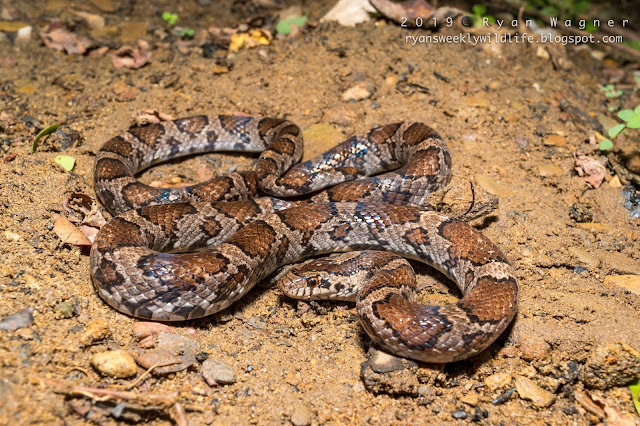
Herping with Conant
Eastern Milksnake.

Today, man-made cover is still important for finding snakes.  Plywood boards and tins scattered throughout the roadsides and hilltops of southern Ohio are easily flipped and are a proven way to find scads of snakes in an otherwise desolate landscape.  Reptiles aren't picky; old pool liners, ratty carpets, deck chairs, smashed televisions, and gas tanks might be an eye sore for most hikers, but for folks like us, they’re a treasure trove.  A good trash pile always gets my blood pumping in anticipation of what might be lurking below.

During the course of our search, Carl and I might flip upwards of 100 pieces of cover and hike ten miles through the ravines and hilltops, all to find a handful of serpents.  Somedays, the snakes are plentiful, others require hours of work to find the most common of species.  There is really no telling where or when a species might turn up; it's often a matter of being in the right place at the right time. 

Carl Brune and Ryan Wagner herping adventures
Eastern Wormsnake.
Carl and I have been lucky enough to find more snakes in Ohio than most people will see in their entire lives.  Even where snake populations appear stable, however, the impacts of humans are plainly visible.  Whether it be road mortality, habitat loss, or direct persecution, "snakes engender mighty little sympathy from the general public," a statement that still rings true today. 

Conant was well aware that with each decade, more species were pushed closer toward extirpation.  Fifty years after his surveys, Conant lamented that, “many places that once supported thriving colonies of various species have vanished.”  Rattlesnakes, spotted turtles, Kirtland’s snakesspecies Conant would have commonly encountered in his dayhave all but disappeared from most of the state.

Ryan Wagner and Carl Brune Herping In Ohio
Timber Rattlesnake.  

Conant laid the ground work for our modern generation of herpetologists.  It is now up to us to protect the species and populations that remain.  Efforts to mitigate the damage we have done to our natural environment can often seem confusing and convoluted, but I have found there is something very down to earth about the study of reptiles and amphibians.  Even someone unaccustomed to the complex and long-winded jargon of scientific literature might be able to detect a hint of the adventure and mystery only thinly veiled behind tables of snout-vent lengths and scale counts.

Hobby, obsession, the ‘weird’ cousin of birding, call it what you will, but herping has captivated my life ever since I first opened Roger Conant's field guide.  In a few months time, the snakes, lizards, and turtles will begin to emerge from their frozen retreats. Carl and I will soon be back among the rolling hills of Southern Ohio, flipping logs, boards, and carpets for the secrets hidden beneath.  Only time will tell what we find.

Herping Ohio Nature Snake Hunting
Carl and myself after a day of dip netting for salamanders in 2018.
Ryan Wagner is a student studying Wildlife Biology and Conservation at Ohio University.  He is an avid herper, birder, nature blogger, and wildlife photographer.  You can read more of his articles at ryansweeklywildlife.blogspot.com or follow him on twitter @weeklywildlife.  You can read the guest post version of this blog at Jim McCormac's Birds and Biodiversity Blog.


Friday, June 22, 2018

Rarer than a Rattlesnake

Herping Adventures Ohio
Carl and I trudged through the ridge tops and ravines of southern Ohio that seemed to be growing increasingly familiar with each visit.  It was a warm, June morning, partly cloudy and gaining humidity with each passing hour.  Our goal for the day: stumble upon one of the timber rattlesnakes (Crotalus horridusthat Carl had observed here over the past several years.  “It would be better if it were more cloudy,” Carl observed, as the first few minutes of searching turned into several hours.  Rattlers (and most snakes for that matter) prefer to bask on days that are cool and cloudy.  Hot, sunny days warm too quickly, providing ample energy for these cold-blooded creatures to move and hunt.  This makes stumbling upon an individual sitting out in the open much less likely.  In the heat of summer, mid-day temperatures can even be too warm, forcing snakes and other herps below ground to avoid overheating.  As is true for most wildlife, there is a sweet spot that makes searching much more efficient.

With the partial cloud cover, we still had hopes that a rattlesnake might be out and about.  However, it takes an insane amount of luck to actually spot a basking rattler.  Their camouflaged bodies make them difficult to distinguish from the surrounding brush and woody debris.  Add in their tendency to conceal their coils beneath the leaf litter with nothing but their triangular head protruding, and you have one very tricky, if not somewhat risky, snake to be searching for.  I stepped gingerly over each fallen tree, scanning the ground to avoid stepping on any hidden rattlesnakes or copperheads.  Carl crouched down to illuminate the interiors of every hollow log we came across.  Once, after discovering a timber rattler at the back of a hollow log, Carl set up a game camera to record its behaviors, only to watch an unseen second and third rattlesnake emerge from the same log.  When conditions are right for snakes, they can really surprise you.  “When it rains, it pours,” Carl always says.

Herping Adventure Ohio
A carpet "cover board" in Southern Ohio.
I’ll save you the suspense; we did not find any timber rattlesnakes despite several hours of hunting.  As it became evident that luck was not on our side, I began scanning the trees for another dense woodland herp: the broad-headed skink (Plestiodon laticeps). The largest of Ohio’s lizards, broad-heads can grow over a foot in length.  Carl has seen only a few individuals of this species over the years.  They too, emerge to bask only when conditions are perfect—not too hot and not too cold.  Conditions were not perfect.

Hot, sweaty, and with nothing to show for all our work except a couple of box turtles, we decided to switch tactics.  Rattlesnakes would have to be found another day.  As I have described in many of my previous posts, Carl has cover boards strewn throughout the preserves and parks of southern Ohio.  His nearby boards and carpets hadn't been checked yet this year, and some had even gone several years without being flipped.  “I usually like to check all my boards every spring, just to make sure they are still there,” Carl explained.  Weathering and overgrown brush take their tole on cover objects.  After a few years in the elements, boards start to warp and decay.  Depending on the material and quality of plywood, some can last ten years, others just two.  The greatest threat to cover, however, is other people.  Dump piles get cleaned up (something I would have thought good before learning their true potential).  Scrappers quickly claim any metal sheets they come across.  Plywood is often used for bonfires or target practice.  Even old, ratty carpets occasionally disappear for reasons unknown.  

Field life
Reaching one set of carpets and boards, I was surprised to see them already flipped and lying at odd angles. Distinct squares of bare dirt outlined where the boards had previously lain.  My thoughts conjured up rival herpers, carelessly leaving our boards a mess after discovering the treasures below.  Carl had another interpretation.  “I’m gonna blame that one on a bear,” he chuckled.  He wasn't kidding either.  As we searched through a few piles of wood along the road, we found a tree stump (under which Carl had once found a rattlesnake) that had clearly been ripped to shreds by heavily clawed arms.  Every year, Carl observes a few black bear signs, from demolished stumps to fresh paw prints.  Rattlesnakes aren't the only thing to be wary of in these parts.

After our failed search for the timbers, it was nice to finally see some snakes.  We flipped several ring-necked snakes (Diadophis punctatusthroughout the day.  Ring-necks are an attractive species, with a bright yellow-orange belly on a shiny gray background.  They never bite, but I’d rather they did.  Their only defense is to splatter their captor with a sticky, stinky, yellow goo from their cloaca.  Most snakes musk when caught, but ringnecks top the list for the stinkiest species I’ve had the pleasure of encountering.  They smell so bad that I usually avoid handling them at all.  Carl wanted pictures so I got a hand and an arm splattered with the vile liquid.  Fun.

Field Life
The day also revealed a few eastern milksnakes, as well as a too-fast-to-catch black racer (which I still chased after rather ridiculously), and an eastern black kingsnake.  As my water reserves began to run low, and the shadows lengthened, we came to a series of old carpets that Carl had placed in a field surrounded by woodland.  As we each flipped one end of the carpet my eyes immediately darted to a miniature snake coiled at my feet.  For a moment I couldn’t believe what I was seeing.  I cupped my hands over the little snake to prevent its escape.  “It’s—it’s a red-bellied,” I stammered, knowing how unlikely this find was.  Peering skeptically down at my cupped hands, “it is,” Carl confirmed distantly.  He scooped the snake up as it made a break for the nearby brush.  “I sometimes go years without seeing this species,” Carl commented reverently.  

Northern red-bellied snakes (Storeria occipitomaculata occipitomaculataturn up with little reliance across the 12 scattered Ohio counties where they occur.  They rarely utilize cover, except when gravid (our chunky female appeared to be full of babies), making them a challenging species to target or survey.  Red-bellied snakes turn up on the crawl once in a blue moon.  Their small size likely leads them to be overlooked much of the time.  Growing fewer than a foot in length, they are very similar in appearance to the more plentiful Dekay’s or brown snake (Storeria dekayi), but that bright red belly makes them unmistakable.  The red-bellied's diet is also more specialized than the Dekay’s, preferring to eat snails and slugs.


Field Life
Carl reveals the red-bellied snake's namesake.
I had seen a red-bellied snake some five years prior in northern Ohio while herping with my father.  The little gray-brown snake had slithered out on the trail in front of me during a hike.  I thought for certain I had found a Dekay's snake, that is, until I flipped it over.  At the time, I didn't realize how unusual of a find it was.  Carl has found just a handful over the past 15 years despite his best efforts to learn more about the species.  They turn up in all sorts of habitats, from wetlands and fields to dry forests.  Of all the snakes Carl finds in southern Ohio, red-bellieds seem to be the scarcest.  They are rarer than rough greensnakes, rarer than hog-nosed snakes, and yes, rarer than rattlesnakes.  

Despite the scarcity with which red-bellied snakes are found, they lack any official state listing.  Very little is known about Ohio's populations.  Red-bellieds aren't rare across much of their range, which extends throughout the eastern US.  In areas like New York, they can be as common as garter snakes.  The population in southern Ohio just seems to be downright confusing.  

Field LifeIt’s the unexpected finds like this that keep me coming back for more.  No matter what species is on your list for the day, you never know what might turn up.  One thing is for certain, you wont find anything sitting inside on a computer.  To have luck, you need to go where the snakes are. 

Thanks for reading and keep living the field life!
RBW

More Articles