In one hand I hold my camera, in the other I fumble to dial my iPhone. Rain is pattering all around me, down the brim of my hat, and fogging my glasses. I am crouched along the side of a back country road in Athens, Ohio. To one side of me, agricultural fields stretch out into the hazy darkness; on the other, a steep hill obscures my view of the residences above. If anyone had glanced out their window at that moment, I’m sure I would have looked like an ominous figure, silhouetted against my car’s high-beams.
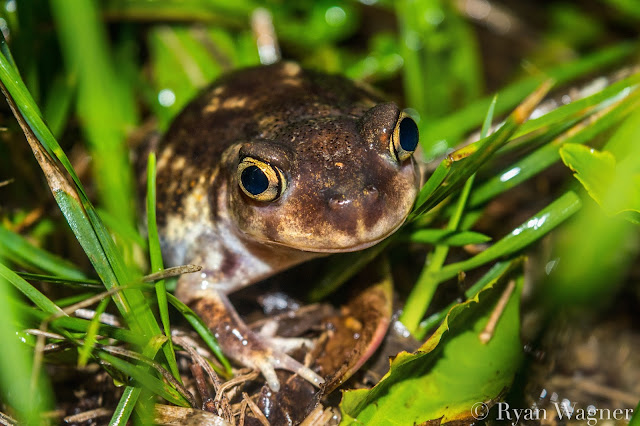
The phone rings; Kyle Brooks picks up on the other end. Before he has a chance to say anything, I stammer out, voice shaking with excitement, “I’m staring at two spadefoots!” “Ooooh, aaah, OK,” he replies, “I’ll be right down.” 15 minutes later, I spot the headlights of a car creeping down the road. I am wary at first, being out here all alone in the dark. Minutes ago, a woman had yelled from her car window, “watch out for a man, emerging from the fields or brush. He has given the neighbors problems around here.” But then I see the car stop, and the beam of a flashlight waving about. The light focuses on something on the road, and I hear a distant cheer of delight.

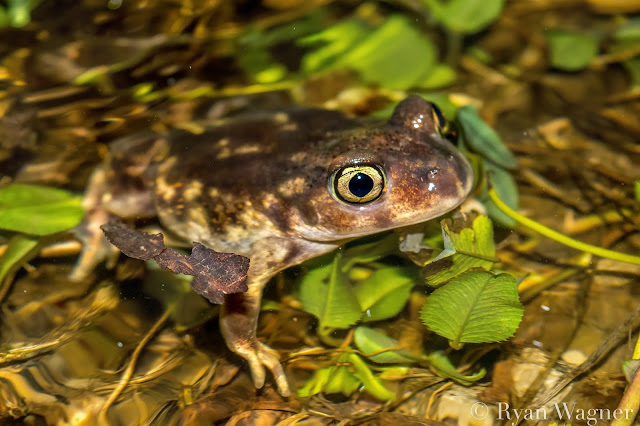
I jog up to see Kyle, Marcel, and Cassie, all running around in a flurry of excitement, illuminating toads and frogs on the road. “They’re everywhere! Spadefoots everywhere!” Cassie squeals. I kneel down to examine one of the pudgy, little amphibians—more closely resembling the consistency of warm play-doh than flesh. It’s skin is yellow and purple-ish brown. The wide-set eyes are luminous gold with unsettling, vertical pupils. The toads don't seem to be in any hurry, as they plop along the road at their leisure.
 |
| Eastern spadefoot distribution in Ohio. Map courtesy of the ODNR. |
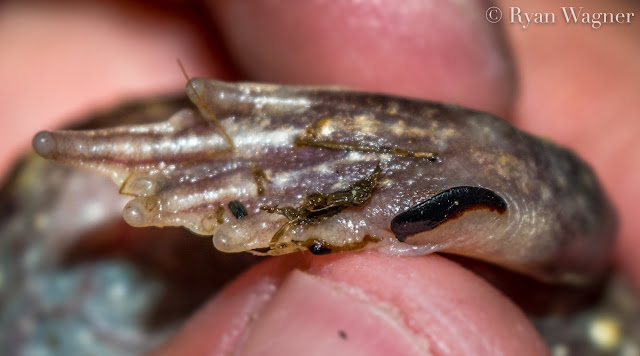
Eastern spadefoot toads (Scaphiopus holbrookii) are notoriously difficult to find. These endangered frogs are at the very northern tip of their range, occupying just a half dozen Ohio counties. To make matters worse, spadefoots spend the majority of their lives buried under the earth. They only emerge on warm nights from April to July, when their sandy homes become flooded with heavy rains. The peculiar name, spadefoot, comes from a distinct adaptation to their fossorial life. The heels of their rear feet display a hardened, sickle-shaped protrusion, used for burrowing.
My journey to find these illusive amphibians began several months prior. I had been scrolling through my Facebook feed, checking for interesting wildlife sightings and keeping up to date with the seasonal migration of song birds, when I stumbled upon a post by Jim McCormac. Jim, a renowned Ohio wildlife blogger, had posted photos of some eastern spadefoots he had found the previous Friday, and a location for his sightings—Athens, Ohio. I made a mental note to ask around the OU Wildlife Club to see if anyone knew of where I could seek these endangered toads. “No,” Kyle Brooks, club president, informed me, “locations for rare animals like that are usually kept secret.” And besides, the toads would have emerged that night, and that night only, while the weather was temporarily perfect. That was that.
I forgot about the spadefoots until a chance encounter with Jim McCormac himself on the Cedar Bog boardwalk in Champaign County. After introducing myself and talking to him about what I was there looking for (Massasauga rattlesnakes), I remembered the spadefoots. He agreed to send me the location where he had seen them, and told me, “They start calling around 10 pm, a little later than the other frogs.”
Over the coming weeks, my mind was on the weather. There were a few rainy nights, but nothing heavy enough to bring out the fastidious frogs. Then, on a day in late June, the forecast was perfect. It rained off and on all day, and looked to keep raining well into the night. It was steady, full rain, reaching a heavy downpour by late evening. I sat anxiously, waiting for dark, passing the time reading Lost Frogs by Robin Moore.
At twenty to nine, I couldn’t take it anymore. I grabbed my boots, headlamp, and camera, and rushed out the door. As I pulled off the highway, I started scanning for movement. I dropped my speed to around 20 miles per hour (the fastest I’m comfortable road cruising). It was a good night for amphibians; I spotted several Cope’s gray treefrogs and American toads hopping across the road. The night air rattled with the trills of treefrogs; but the bizarre whine of the spadefoot never came.
I sat in my car, listening to the frogs and the steady rhythm of the rain. Then, just within the range of my headlights, I saw an amphibian hopping across the road. The frog was about the size of an American toad, but something about it struck me as unusual. As I jumped out of my car to get a closer look, the face stood out—yellow eyes. I stared in disbelief, unsure if what I was seeing was real. Those yellow eyes could only belong to one frog—the eastern spadefoot.

By the time Kyle, Marcel and Cassie arrived, the toads were emerging from the fields, crossing the road, and burying themselves in the sandy, unplanted field on the other side. During this short-lived spectacle, we saw around 15-20 spadefoots. They were a lifer (a new species) for all of us. “Spadefoots were a species I never thought I would see in Ohio,” Kyle would later tell me.
The entire time we were searching (well past 10 pm) we never heard the spadefoot’s distinct whaar call. The rains, while heavy enough to bring the toads above ground, hadn't created the temporary pools the spadefoots needed to lay eggs. There wouldn't be any courting tonight, just movement to more productive feeding grounds. Within hours, the toads would be back below the earth—leaving no evidence of their terrestrial activities.
Ohio’s only endangered species of frog, the eastern spadefoot needs our help. To date, only five distinct breeding populations have been recorded in Ohio. These toads require river valleys with sandy soils where rain water can collect to form breeding pools. Sites that meet these requirements have been repeatedly paved, developed, or planted. Road mortality and pollution continue to decimate spadefoot numbers. Being such a secretive amphibian, few ever get the chance to see these toads or hear their curious calls.
We need to act now to save these magical and mysterious amphibians before it is too late. You can help by participating in FrogWatch, a citizen science program designed to document species of calling frogs. Participating in this project was one of my first introductions to science and my local environment. It is an excellent way to learn more about native frogs, as well as help scientists to understand long term population trends and range distributions. Don’t the bizarre, the slimy, and the inspiring deserve a place in our world and in our hearts? We can make a difference.
 |
| Eastern spadefoot population statistics. Graph courtesy of the ODNR. |


